Althea sollte in keinem Vergleich von Consumer-VPNs als VPN erscheinen, und dieses Dossier existiert hauptsächlich, um genau das zu betonen: Das Projekt startete (2017–2019) als dezentraler ländlicher ISP, bei dem die gerouteten Router von Nachbarn sich gegenseitig pro GB in Stablecoins bezahlen und ein vom Nutzer gewählter Exit-Knoten – funktional ein VPN-ähnlicher Ausgang – den Tunnel beendet und die rechtliche Haftung des ISPs trägt. Dieses Mesh-ISP-Geschäft existiert weiterhin (Fierce Network 2024: 13 US-Bundesstaaten und 4 Länder, Betreiber wie Hawk Networks und Wave 7 verkaufen Prepaid-Internet), aber die Unternehmensenergie hat sich hin zu Althea L1 verlagert, einer Cosmos+EVM-Mikrozahlungs-Blockchain, deren ALTHEA-Token im September 2025 mit Überweisungen live ging, im Oktober 2025 auf ein Allzeithoch von 6,13 $ anstieg und seitdem um 99,9 % auf eine Marktkapitalisierung von 118 k $ mit null Handelsvolumen in 24 Stunden eingebrochen ist (CoinGecko, abgerufen am 2026-11-03). Es gibt hier nichts, was man gegen Mullvad oder Proton bewerten könnte: keine App, kein Konto, kein Kill-Switch, keine Logging-Richtlinie zur Überprüfung – nur ein Protokoll, bei dem Fremde deinen Datenverkehr routen und ein Rechenzentrum-Ausgang (betrieben von dem Unternehmen, das dein lokales Netzwerk betreibt) ihn unverschlüsselt sieht. Gemäß dem Versprechen der Website weigern wir uns, einen selbstgehosteten Tunnel mit einer kostenlosen App zu vergleichen: Althea wird so bewertet, wie es ist – als Open-Source-dezentrales ISP-Protokoll mit angehängtem Token – und auf dieser Grundlage lautet die ehrliche Einschätzung: tatsächlich interessante Infrastruktur, keine überprüfbaren Datenschutzgarantien und ein Token, dessen Markthistorie eine Warnung darstellt.
Open SourceKrypto akzeptiert5 rote FlaggenFakten verified - operator pages (althea.net, althea.org, docs.althea.net x3 pages, blog.althea.net x3 posts, GitHub org + rita repo, whitepaper v2.1 PDF), trade press (Fierce Network), news (Decrypt 2020, Oregon Business 2019), CoinGecko token page, Privacy Guides, HN Algolia API and Reddit arctic-shift archives (thread-level link_id fetches) all fetched live 2026-11-03; arctic-shift body/title keyword search returned 422/429 repeatedly this session (known failure mode), so Reddit evidence was gathered via thread/link_id endpoints; doc.althea.org is dead (DNS/connection failure - the docs moved to docs.althea.net); medium.com/althea-mesh (403), republic.com (403), allaboutcircuits.com (403), figment.io (403) and direct reddit.com (403) were NOT fetchable this session; hawknetworks.net returned 200 but only renders a JS shell so its content could not be read
Token trajectory: transfers unlocked September 8, 2025 (blog); ALTHEA hit $6.13 on October 8, 2025 then collapsed to $0.0081 (-99.9%) with $0.00 24-hour volume and no active trading pairs per CoinGecko (fetched 2026-11-03) - a classic post-unlock pump-and-dump shape around an infrastructure token whose utility is chain gas
2019 production incident: a gas-price bidding collision with an airdrop-exploit script stalled Ethereum payments and degraded the entire live Clatskanie ISP for hours - the company's own postmortem concludes 'modern blockchains are simply not reliable enough' for unattended payment (blog.althea.net dev update 70, fetched 2026-11-03); billing cutting users off over failed chain payments is a structural risk of crypto-metered internet
Community trust damage is documented by its own subreddit: a 2022 commenter found the redesigned website 'scream[ed] scam' (no visible pricing, vague marketing, no mention of the pivot) and questioned the then-$400M valuation ('lot's of scams have high market caps initially'); another aspiring node host was ignored for months (r/altheamesh, fetched via arctic-shift 2026-11-03)
+2 weitere rote Flaggen - vor der Anmeldung aufklappen
Marketing drift: the same thread flags 'Gamer Fast' marketing the community disliked, and the current homepage leads with DeFi/RWA language ('Liquid Infrastructure', tokenized fiber and cell towers) while the actual internet product is relegated to a 'Looking for internet services? Visit Hawk Networks' footer link
Old subreddit r/altheamesh is 90% airdrop spam since mid-2023 - the public community channel was effectively abandoned
Review
Entwurf von Qwen3, faktengeprüft von der vpnvergleich-Redaktion · Review-Version 2 · Text aktualisiert 2026-11-03 · Fakten Stand 2026-11-03 · wie wir verifizieren
Ehrlichkeits-Hinweis: wir haben keine eigenen Tests zu Althea gelaufen (Leak-Tests, Tempo, Kill Switch). Alles auf dieser Seite ist quellbasierte Meta-Recherche mit datierten Links. Sobald wir testen, erscheinen die Ergebnisse hier und im Änderungsprotokoll.
Overview
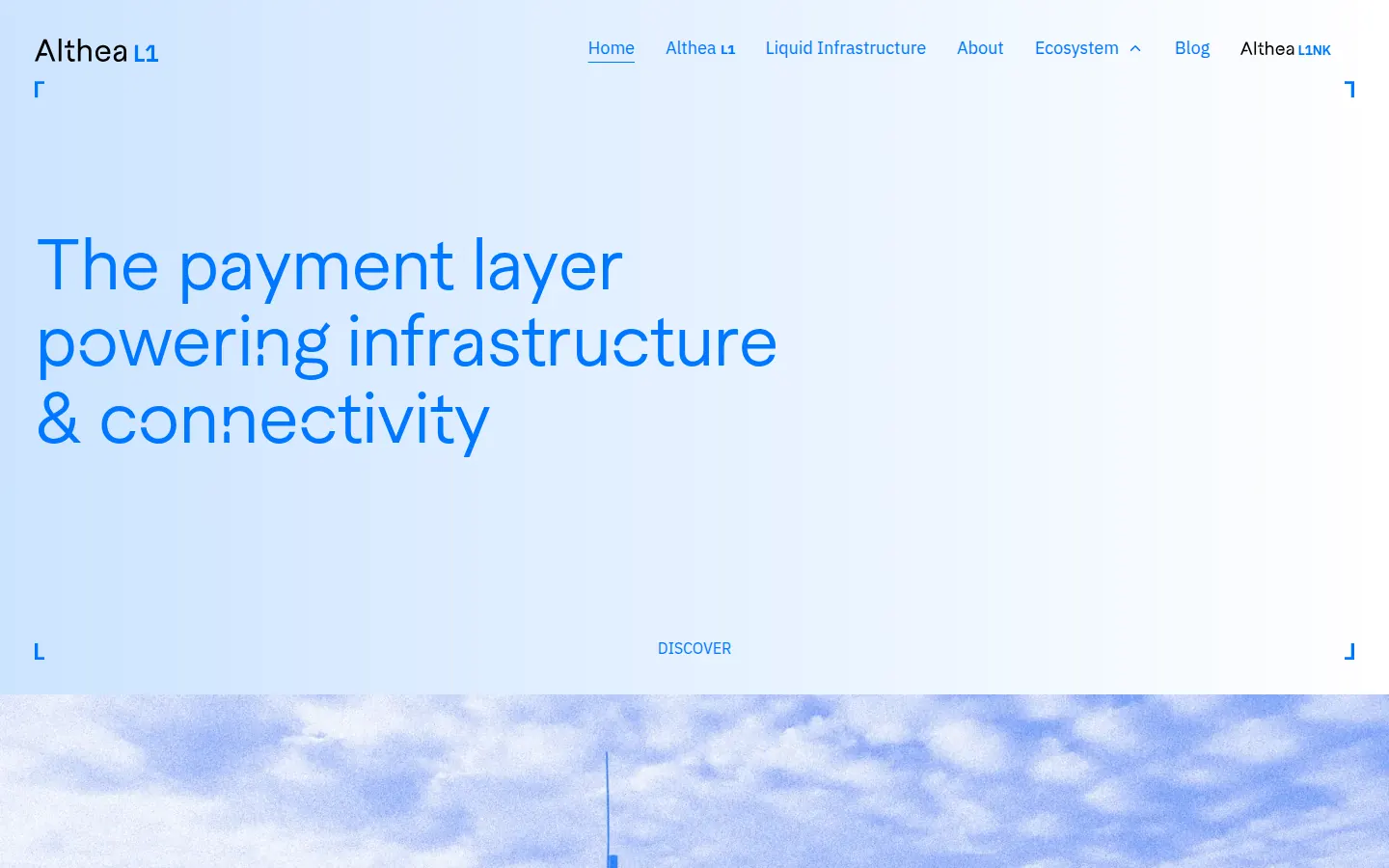
Althea homepage - live capture 2026-09-29
Althea is not a consumer VPN - it’s a decentralized ISP protocol and L1 blockchain where routers pay each other in stablecoins for bandwidth, with a user-chosen exit node handling internet egress. Run by Hawk Networks (CEO Deborah Simpier), it operates in 13 U.S. states and four countries, but there is no app, account, or subscription. You’re not buying privacy software; you’re joining a pay-per-GB mesh network where the exit sees your traffic.
Logging & privacy
Althea claims architectural privacy: WireGuard tunnels encrypt traffic from user to exit node, so intermediate routers only see ciphertext. The exit node, however, sees unencrypted data and carries ISP legal responsibilities like copyright enforcement. This is a design claim (policy-only evidence), not audited or court-tested. No logging policy, transparency report, or third-party audit exists. Jurisdiction is the U.S., and each exit operator sets their own practices - yours may log, and you have no way to verify.
Pricing & the renewal trap
There is no subscription pricing - users pay per-GB micropayments via stablecoin, topped up through local operators like Hawk Networks or Wave 7. Fierce Network (2024) reports consumers typically prepay $25-$50 monthly. The system throttles to baseline speeds (a few Mbps) when funds run out, but doesn’t disconnect. Since there’s no fixed plan, the derived_pricing fields are null - this is usage-based billing, not a renewal trap, but a blockchain payment dependency that failed live in 2019.
Features & performance
The protocol uses WireGuard for encrypted tunnels between routers and supports Linux and custom router firmware (OpenWRT). No kill switch, split tunneling, multihop, or obfuscation is documented - traffic is standard WireGuard. P2P is possible depending on the exit, but streaming and dedicated IPs are unsupported. There are no centralized servers; the network is built from user-deployed routers. Open-source (Apache-2.0), but no performance benchmarks are available - this is infrastructure, not a tested consumer service.
Ownership & track record
No central owner is listed, though Hawk Networks (led by Deborah Simpier) operates the platform. The 2019 Clatskanie ISP outage - caused by Ethereum gas-price collisions - proved blockchain payments aren’t reliable for unattended systems. Community trust eroded by a vague website redesign, unanswered support requests, and a $400M token valuation with little real-world scale. The ALTHEA token, launched in 2024, spiked to $6.13 in October 2025 then collapsed 99.9% to $0.0081 with zero trading volume - classic pump-and-dump signs.
Censorship resistance
Althea offers no obfuscation - traffic is standard WireGuard, easily detectable and blockable. It is not suitable for use in China, Iran, or Russia. The protocol relies on public blockchain transactions and direct peer-to-peer tunnels, making it vulnerable to network-level filtering. There are no known deployments in censored regions, and no tools exist to disguise traffic as regular HTTPS.
Verdict
Do not use Althea if you want a VPN - there is no consumer product, no privacy guarantee, and no support structure. It’s a niche decentralized ISP protocol with real technical promise but unproven reliability and a dead token market. The money-trail is opaque: Althea doesn’t pay review sites because no review site covers it - there’s nothing to review. For privacy, stick with audited, independent providers.
++ Was hält stand
Echt neuartiges Open-Source-Protokoll: Rita-Routing/Abrechnung ist Apache-2.0 Rust, Firmware AGPL-3.0, Whitepaper öffentlich – die Datenschutzarchitektur (WireGuard-Tunnel vom Benutzer zum Exit, mittlere Knoten sehen nur Chiffretext) ist im Code überprüfbar (GitHub + Whitepaper abgerufen am 2026-11-03)
Reale Einsätze mit echten Nutzern, kein Vaporware: Community-Netzwerke in 12 US-Bundesstaaten und 4 Ländern, 10.000.000 GB geroutet im Jahr 2025 (Betreiber-Homepage, abgerufen am 2026-11-03); ländliche Clatskanie-Kunden zahlten unter 40 Dollar pro Monat für 50–60 Mbps gegenüber ~150 Dollar bei traditionellen ISPs (Oregon Business 2019)
Pay-as-you-go ohne Vertrag und mit gedrosselter, immer aktiver Notfallverbindung, wenn die Wallet leer ist – eine Barrierefreiheitsfunktion, die herkömmliche ISPs und VPNs nicht anbieten (Decrypt 2020, Fierce Network 2024)
Exit-Knoten-Modell überträgt die rechtliche Verantwortung eines ISPs (Urheberrecht, Adressübersetzung, FCC-Formular 477) auf professionelle Exit-Betreiber statt auf Privatanwender, die ihre IPs teilen (Whitepaper v2.1; r/altheamesh Rechtsdiskussion 2019)
-- Worauf du achten solltest
Kein Consumer-VPN im herkömmlichen Sinne: keine App, kein Konto, kein Abonnement, kein Kill-Switch, keine Serverliste – 'Althea' zu kaufen bedeutet, einen Vertrag mit einem lokalen ISP-Betreiber abzuschließen, der das Protokoll nutzt
Keine Prüfung irgendetwas Datenschutzrelevanten: der architektonische No-Interception-Ansatz ist rein politisch; keine unabhängige Code-Prüfung, keine Logging-Prüfung, kein Transparenzbericht in dieser Sitzung gefunden
Das ALTHEA-Token ist effektiv tot als Markt: -99,9 % gegenüber dem Allzeithoch im Oktober 2025, etwa 118.000 USD Marktkapitalisierung, null Volumen in 24 Stunden, laut CoinGecko 'Handel eingestellt' (abgerufen am 2026-11-03)
Der vom Nutzer gewählte Exit-Knoten sieht den gesamten unverschlüsselten Zielverkehr – in der Praxis den lokalen Betreiber-Exit, sodass das Datenschutzmodell darauf zusammenbricht, einem einzigen Unternehmen pro Netzwerk vertrauen zu müssen
Die Community-Präsenz ist zurückgegangen: r/altheamesh wurde seit 2023 mit Krypto-Airdrop-Spam überflutet, und der letzte echte Nutzerbeitrag (Februar 2025 'Gibt es Althea noch?') erhielt nur eine zweisätzige Antwort, die auf Discord verweist
Preis-Realitätscheck
Einführungspreis
auf der Anbieter-Website
Hinweise
Es gibt kein Consumer-VPN-Abonnement, das preislich zu bewerten wäre. In einem Althea-Netzwerk hält der Router des Nutzers eine Stablecoin-Wallet und tätigt Mikrozahlungen pro GB an jeden Nachbarn, der Daten weiterleitet, sowie eine separate Zahlung an den Exit-Knoten (Whitepaper v2.1, abgerufen am 2026-11-03). Beispiele aus der Presse: Fierce Network (Mai 2024) zitiert CEO Simpier zur Beschreibung von Prepaid-Aufladungen – 'streichen ihre Debitkarte und laden 25 oder 50 Dollar oder so auf, um einen Monat lang auszukommen'; Oregon Business (2019) dokumentierte die Clatskanie-Genossenschaft, die 50–60 Mbps für unter 40 Dollar pro Monat anbot, im Vergleich zu etwa 150 Dollar pro Monat bei traditionellen lokalen ISPs. Die Zahlung läuft über den lokalen Betreiber, nicht über Althea.
Der Geldfluss - was Testportale mit dieser Empfehlung verdienen
Affiliate-Status noch nicht verifiziert
Sollten wir dieses Programm joinen, wird jeder Link hier rel="nofollow sponsored" und läuft über /go/. Bis dahin zeigen unsere Links direkt auf die Anbieter-Website, ohne jegliches Tracking. Die Ranking-Logik kann Affiliate-Felder physisch nicht lesen - hier der Beweis.
On the website
Captured by our screenshot bot from the live site (or its public archive). A capture is evidence of what the page showed at capture time - not an endorsement.
Althea homepage - live capture 2026-09-29
Bevor du zahlst: prüfe den Verlängerungspreis, das Erstattungsfenster und ob ein günstigerer oder Gratis-Weg deinen Anwendungsfall abdeckt - die ehrliche Checkliste.
Stand unserer Prüfungen: 2026-11-03. Althea erreicht 2.6/10 in unserem gewichteten Review. Wir haben 5 rote Flaggen vermerkt (oben aufgelistet). Nutzerberichte, Eigentum und die Vorfallhistorie sind mit datierten Quellen im Meta-Review unten dokumentiert.
What do I actually get with Althea?
You get open-source router firmware that joins a decentralized network where you pay per gigabyte via stablecoin. There’s no app, no account, and no central service - just a protocol where your router pays neighbors and an exit node for internet access.
What is the renewal price and total cost over three years?
There is no renewal price - billing is per-GB usage. The derived_pricing fields are null because costs depend on data use and local operator rates. Prepaid top-ups of $25-$50 per month are typical, but long-term totals are unpredictable.
What evidence supports Althea’s no-logs claim?
None. The privacy claim is architectural (policy-only): traffic is encrypted between user and exit, but the exit sees everything. No audits, court tests, or logging policies exist. You must trust your exit operator completely - and you can’t verify their practices.
Can I use Althea in a censored country like China or Iran?
No. Althea uses standard WireGuard tunnels with no obfuscation, making it easy to detect and block. It has no features for evading firewalls and is not designed for use in high-censorship environments.
Can I pay anonymously?
Partially. There’s no account signup, but you top up via operators who may require KYC. Some used debit cards via Wyre (KYC’d), and stablecoin sources vary. Your identity exposure depends on the payment method and operator - not Althea itself.
What happens if Althea shuts down?
The protocol is open-source and decentralized, so existing networks could persist. But the L1 token is dead (zero volume), and community activity has collapsed. If operators abandon it, your router stops getting paid - and your internet slows or fails.
What’s the honest free or cheap alternative?
For real privacy, use Mullvad, IVPN, or Proton - audited, independent, with kill switches and anonymous payment. For free options, consider self-hosted WireGuard on a VPS, but know you’re trusting the VPS provider. Althea isn’t a cheaper VPN - it’s a different beast entirely.
Der Meta-Review: was das Internet über Althea sagt
Wir erwarten nicht, dass du uns vertraust. Dieser Review ist ein Meta-Review: unten siehst du, was andere Testportale behaupten - mit ihren Interessenkonflikten gekennzeichnet -, was Nutzer auf Reddit und in Foren berichten und wer Althea wirklich betreibt. Jede Behauptung verlinkt ihre Quelle, damit du sie selbst prüfen kannst.
Was andere Tester sagen (3)
Jede Quelle trägt ein Konflikt-Label aus unserer Testportal-Datenbank. „Affiliate-finanziert“ heißt: Die Seite verdient mit, wenn du kaufst, was sie empfiehlt. Kritische Stimmen nehmen wir bewusst auf.
Fetched 2026-11-03 (HTTP 200): interview-based feature; 'Launched in 2017'; Deborah Simpier is 'CEO of Hawk Networks (the company behind the Althea platform)' and calls Althea a 'Linux of the internet'; consumers top up routers by debit card ($25-$50 to last a month) and can pick speed/latency/price trade-offs; always-on throttled fallback tier; 'Community-run mesh networks are using the Althea platform and protocol across 13 U.S. states as well as four countries (even in Ghana)'; operators like Wave 7 (North Carolina) are who consumers call; Simpier concedes Althea operators are not ISPs 'in the strict definition' the FCC uses; Liquid Infrastructure tokenizes and fractionalizes network assets.
NOT fetchable this session - HTTP 403 on 2026-11-03 (both webfetch and curl); excerpt visible via search: describes subscribers using cryptocurrency to pay community members who own the routers, price varying by speed, and a baseline-speed fallback when payment runs out. Excluded from live-checked count.
NOT fetchable this session - HTTP 403 on 2026-11-03; search excerpt shows it describes Althea as 'a decentralized, blockchain based protocol for multi-stakeholder networks' with a rural case study going from 8-12 Mbps to over 200 Mbps. Excluded from live-checked count.
Was Nutzer sagen (6)
Reddit, Foren, HN - paraphrasiert und verlinkt, nie aus dem Kontext gerissen. Anekdoten, keine Beweise - aber Erstattungsbeschwerden und Leak-Reports sind das beste Frühwarnsystem, das dieser Markt hat.
Fetched 2026-11-03 (HTTP 200, 25 comments): operator voice (ttk2/Jehan Tremback) on VC funding, subnet DAO revenue, Babel scaling debates with neilalexanderr, gateway/exit discovery; community framing debate ('no one should be speaking of meshs in the context of Althea'); deployment offers (Oregon, Santa Cruz, NYC) and net-neutrality questions.
Fetched 2026-11-03 (HTTP 200): the project subreddit is now ~90% crypto-airdrop spam (Coinbase/Lido/Arbitrum/Curve 'airdrop' posts from mid-2023 onward); genuine posts are mostly one-way team crossposts from Twitter (2022); last real community engagement is 'Althea still around?' (Feb 2025, 1 comment) and 'How much can you make with an Althea setup?' (Oct 2021, 7 comments).
Fetched 2026-11-03 (HTTP 200): would-be node hosts ask about earnings; answers range from 'far from dead... six states and two foreign countries' plus a business-model pivot explanation, to 'seems like a dead project' (node-hosting request ignored for months), 'still pretty early stage... mainly interests people in the internet infrastructure industry', and 2022 skepticism that the redesigned site 'screams scam' with an unjustifiable valuation.
Fetched 2026-11-03 (HTTP 200): the key exit-node legal discussion - community explains only the exit (a VPN-style operator with legal measures) can see traffic and carries legal responsibility while gateway homeowners stay clean; co-founder ttk2 confirms FCC Form 477 is filed by exits on users' behalf; a civil-liberties voice objects that registration requirements defeat the purpose of decentralized networks.
Fetched 2026-11-03 (HTTP 200): the state of the community in the L1 era - two short replies pointing to Discord and X; no discussion of routers, ISPs or users on the subreddit itself.
NOT usable this session - HTTP 422 on first attempt and 429/422 on all retries 2026-11-03 (documented arctic-shift failure mode); the dVPN subreddit's latest 100 posts (fetched via subreddit-only query, HTTP 200) contained no Althea mentions, indicating near-zero current discussion there. Reddit's own search API returned 403 to this server. Excluded from live-checked count; noted in data_quality.
KI-Fakten-Report - alles, was wir wissen, komprimiert
Erstellt von Qwen3 am 2026-11-03 aus unserer Faktendatenbank plus den verlinkten Quellen. Er fasst zusammen - er fügt keine Fakten hinzu. Prüfe alles Wichtige gegen die verlinkten Quellen.
Bottom line: Althea is not a consumer VPN. It is an open-source decentralized ISP protocol where users pay per-GB via stablecoin micropayments routed through a mesh of neighbor-operated routers and a chosen exit node. There is no app, no account, no subscription, and no privacy guarantee you can audit - only a technical claim that middle nodes see only encrypted traffic.
The logging truth: The protocol design claims WireGuard-encrypted tunnels protect user traffic so only the exit node sees unencrypted data, but there is no audited no-logs policy, transparency report, or independent verification of any exit operator’s practices. Jurisdiction is split: the U.S.-based Althea Limited supports the project, but the L1 chain and exit nodes operate globally with no unified legal oversight.
Pricing reality: There is no subscription pricing - users top up a router wallet with fiat or crypto ($25-$50 monthly equivalent) to pay per GB. The model shifts cost and complexity to the user: no flat fee, no refund policy, and service throttles to baseline speeds if funds deplete. Payment KYC depends on the local operator and method, not Althea itself.
What reviewers say vs what users say: Early press (2019-2020) praised Althea’s vision for rural broadband, but no current review sites cover it because there is no consumer product to review. User sentiment, especially on Reddit, turned skeptical by 2022: the website redesign “screams scam,” the $400M token valuation lacked justification, and unanswered support requests suggest neglect - conflicting sharply with the company’s ongoing self-promotion.
Who runs it: Deborah Simpier is CEO of Hawk Networks, the company behind Althea, and a co-founder along with Jehan Tremback and Aaron Kilpatrick. The team operates as Althea Limited (U.S.), but the project’s focus has shifted from community mesh networks to the Althea L1 blockchain, whose token collapsed 99.9% after its 2025 unlock - undermining trust in its current direction.
Quellen & wie dieser Review entstand
Jede externe Quelle, die auf dieser Seite verwendet wird, mit dem Abrufdatum und ihrer Belegklasse [A]-[D] (A = Primär-/Betreiberquelle, B = seriöse Presse/Forschung, C = Community, D = eigene Messungen). Methodik: wie wir verifizieren. Quellen verschwinden oder ändern sich - falls ein Link tot ist, sag uns über die Kontaktseite Bescheid.
Evidence classes on this page:[A] A: 13[B] B: 9[C] C: 6[D] D: 0(D stays empty until our own test phase)
Sentinel is real decentralized-VPN infrastructure - an open-source Cosmos chain with on-chain sessions, Wallet-only signup and per-gigabyte pricing that…
Open SourceKrypto akzeptiert
Einstieg ca. 0,90 € /mo
none verifiable (no legal entity confirmed 2026; on-chain governance via P2P stakers, docs maintained by validator Trinity - whitepaper-era SNT Foundation / Exidio unconfirmable)dezentrales vpn (dvpn) vor 3 Tg.
The most ambitious attempt to replace the VPN trust model with a market - and one of the least convincing products to actually use. The design is real…
AuditOpen SourceKrypto akzeptiert
Einstieg ca. 0,90 € /one-time
United States - Orchid Labs Inc. / Orchid Technologies LLC, 1288 Columbus Ave, San Francisco, CA (Google Play developer listing); bandwidth exits are run by independent third-party providers worldwide, not by the companydezentrales vpn (dvpn) vor 3 Tg.
A genuine dVPN with real scale (22,000+ active nodes in 135+ countries per the network homepage, 45k bandwidth providers per MystNodes, both fetched…
AuditOpen SourceKrypto akzeptiert
Einstieg ca. 2,00 € /mo
Switzerland and Lithuania - Blockdev AG (Alpenstrasse 14, 6300 Zug, footer fetched 2026-11-02) develops the network; the consumer VPN app is operated by UAB 'MN Intelligence' (Lithuanian company form, mysteriumvpn.com footer fetched 2026-11-02); discovery services run by NetSys Inc; terms-conditions-vpn states disputes are governed by the laws of the Republic of Panama with exclusive jurisdiction in Panamanian courtsdezentrales vpn (dvpn) vor 3 Tg.


Noch keine Kommentare - sei der Erste. Das Posten läuft durch einen kurzen Proof-of-Work in deinem Browser (Anti-Spam), kein Konto nötig.