Der Referenzpunkt für Anonymität – aber kein VPN, und dieses Dossier ist ehrlich darüber. Tor ist eine in den USA registrierte gemeinnützige Organisation gemäß 501(c)(3) (gegründet 2006, entstanden aus Forschungsarbeiten des US Naval Research Laboratory aus der Mitte der 1990er Jahre), die ein dezentralisiertes, freiwilligenbasiertes Netzwerk betreibt, ohne zentralen Betreiber, ohne Konten, ohne Preis und ohne etwas zu verkaufen. Logging ist per Konstruktion irrelevant: Es gibt keinen zentralen Ort, an dem Logs existieren könnten, und die Transparenzebene von Tor (öffentliche Relay-Metriken, Finanzberichte, Stellungnahmen zu Vorfällen) hat im kommerziellen Bereich keine Entsprechung. Die Nachteile sind ebenso strukturell: Die Geschwindigkeiten sind per Design langsam (3 Hops, freiwilligenbasierte Knoten – „extrem langsam“, wie die Community selbst betont), Websites behandeln Exit-Knoten mit Misstrauen, Exit-Knoten können unverschlüsselten Datenverkehr einsehen, und die Geschichte der Forschung zu feindlichen Relays (CMU 2014, FBI Freedom Hosting, Projekte von FSB-Subunternehmern) bedeutet, dass das Vertrauensmodell „kein einzelner Vertrauenspunkt“ lautet, nicht „vertrauenswürdiger Anbieter“. Tor wird außerdem staatlich finanziert (OTF, Sida, US State Dept DRL – offengelegt auf der eigenen Sponsorenseite). Wenn deine Bedrohungsanalyse Werbetreibende oder deinen ISP umfasst, ist ein guter kostenpflichtiger No-Logs-VPN schneller und einfacher; wenn es der Staat ist, bleibt Tor mit Bridges die Antwort.
Open SourceCommunity-eigen3 rote FlaggenFakten verified - operator pages (home/ueber-uns/history/download/support/donate/sponsors/metrics/reports/Snowflake), Privacy Guides reference, Wikipedia, Google News, HN index and Reddit archives all fetched live 2026-09-29
Documented deanonymization history: 2014 CMU relay-early attack ($1M FBI contract per HN coverage), FBI Freedom Hosting takedowns, GCHQ 'Tor Stinks' - the adversary model is state-level, not marketing-grade
Browser-exploit surface: JavaScript exploits against Tor Browser have been actively used (HN 2016, 314 pts); Tor is only as safe as its browser discipline
Government-funding lineage (NRL origins, State Dept/OTF money) is public and routinely weaponized in propaganda - understandable distrust driver even though funding is disclosed
Review
Entwurf von Qwen3, faktengeprüft von der vpnvergleich-Redaktion · Review-Version 2 · Text aktualisiert 2026-10-20 · Fakten Stand 2026-09-29 · wie wir verifizieren
Ehrlichkeits-Hinweis: wir haben keine eigenen Tests zu Tor (The Onion Router) gelaufen (Leak-Tests, Tempo, Kill Switch). Alles auf dieser Seite ist quellbasierte Meta-Recherche mit datierten Links. Sobald wir testen, erscheinen die Ergebnisse hier und im Änderungsprotokoll.
Overview
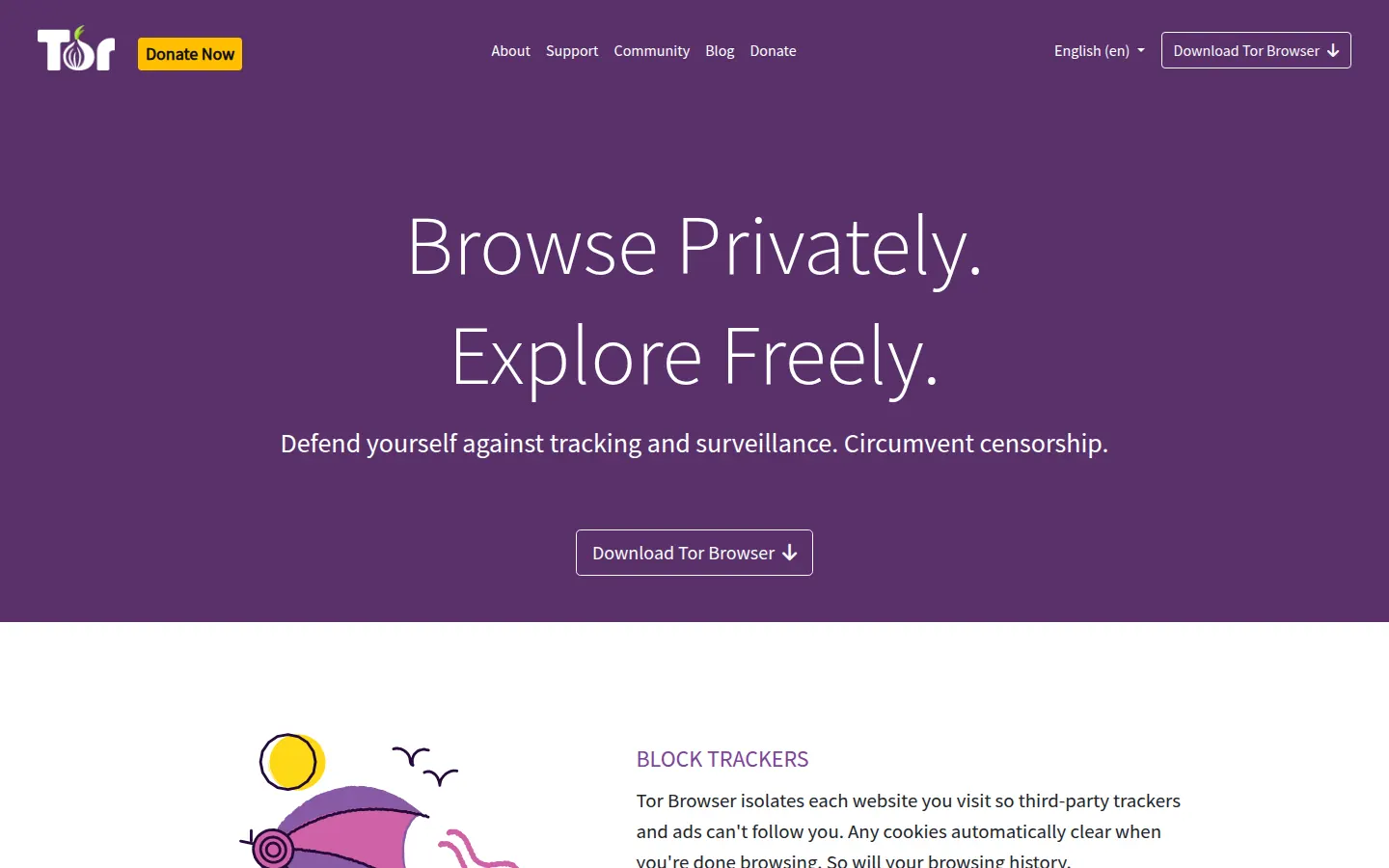
Tor (The Onion Router) homepage - live capture 2026-09-29
Tor is not a commercial VPN but a nonprofit anonymity network built on decentralized volunteer relays, accessible via the free Tor Browser. Operated by The Tor Project, Inc. - a U.S.-based 501(c)(3) since 2006 - it enables censorship circumvention and anonymity through layered encryption across three hops. While structurally designed to prevent central logging, it’s slow by design and unsuitable for streaming or daily browsing, best reserved for high-risk users.
Logging & privacy
Tor’s architecture makes central logging impossible: traffic is split across three volunteer relays, each seeing only one hop, and the Tor Project itself never handles user data. The logging claim is "policy-only" in form, but the network’s design enforces it structurally - there is no central operator to log. Jurisdiction is the U.S., but transparency mitigates risk: public metrics, financial reports, and incident disclosures are published. However, exit nodes can see unencrypted traffic, and state-level adversaries have exploited browser flaws or run malicious relays (e.g., 2014 CMU/FBI attack, GCHQ "Tor Stinks"). No warrant canary exists, and no third-party audits cover the network, though the code is open source.
Pricing & the renewal trap
There is no price: Tor Browser and the network are completely free, funded by donations (starting at $2) and institutional grants. No subscription, account, or payment is required.Tor is free - there is no renewal ratio and no three-year cost, because nothing is billed. You pay nothing, now or later. Payment methods for donations include credit card, PayPal, and crypto, but using Tor itself requires no financial transaction.
Features & performance
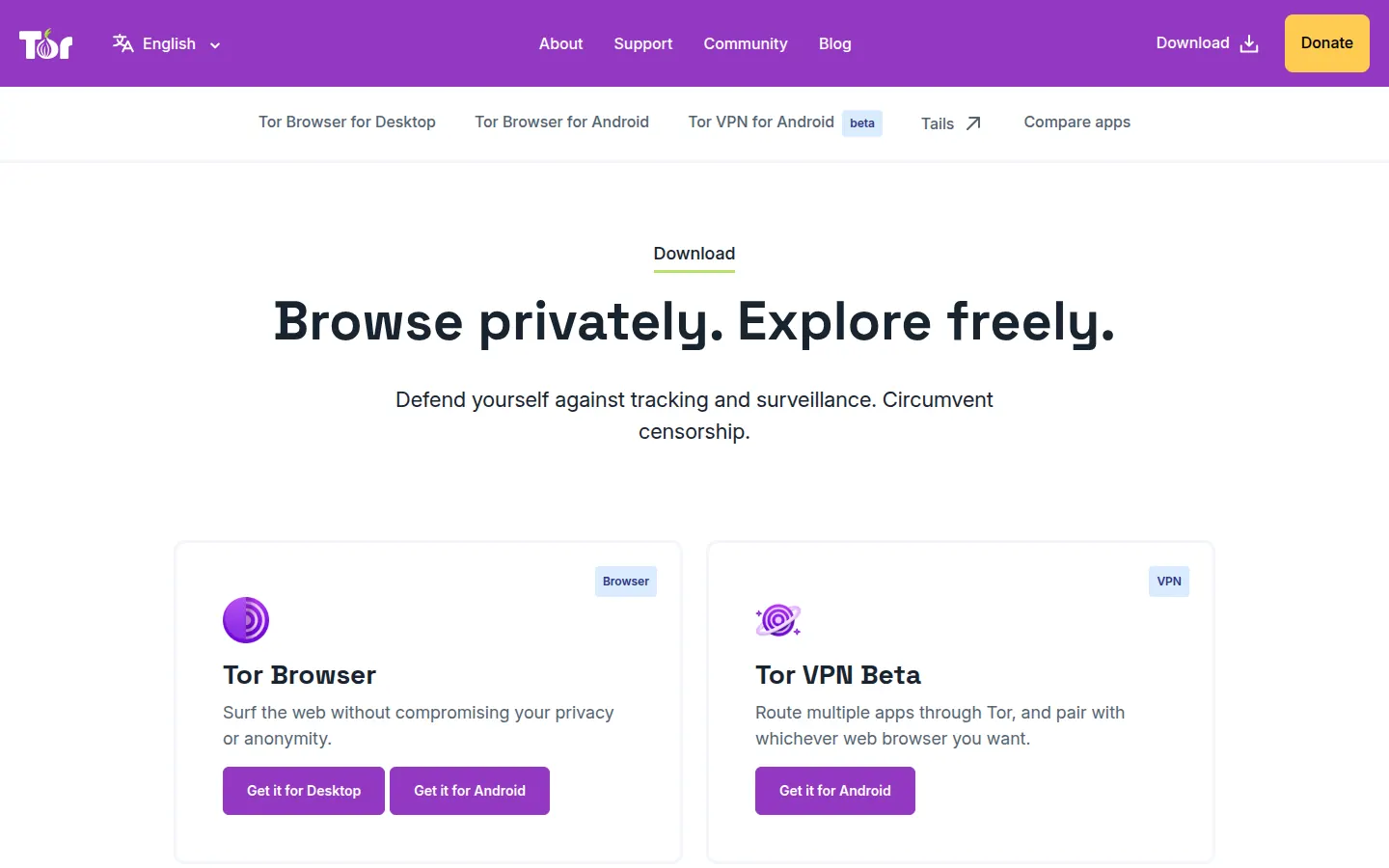
Tor (The Onion Router) apps / download page - live capture 2026-09-29
Tor uses onion routing with layered TLS encryption across three hops, supporting obfuscation via Snowflake, obfs4 bridges, WebTunnel, and meek domain-fronting. It has no kill switch or split tunneling, and multihop is inherent in its design. P2P and streaming are unsupported, and speeds are extremely slow due to volunteer relays and encryption overhead. The Tor Browser is available for Windows, Mac, Linux, and Android. Server and country counts are not published, as the network relies on dynamic volunteer relays. No independent performance tests have been run, but community consensus confirms slow speeds unsuitable for video calls or gaming.
Ownership & track record
The Tor Project is a U.S.-registered nonprofit with no corporate owner, funded by public donations and institutions like the Open Technology Fund, Sida, and the U.S. State Department. Its transparency - public financials, metrics, and incident reporting - is unmatched among privacy tools. However, its origins in the U.S. Naval Research Lab and government funding fuel distrust, despite full disclosure. Documented incidents include the 2014 CMU relay-early attack (used by the FBI), GCHQ/NSA surveillance efforts, and FSB contractor deanonymization attempts. The data_quality is verified, and sources confirm a 20-year history of peer review, attacks, and resilience.
Censorship resistance
Tor is a leading tool for bypassing state censorship, especially when using obfuscation like Snowflake or obfs4 bridges. Snowflake, in particular, is the most-used obfuscation method in Iran (per Tech Policy Press), and the Tor Project actively develops anti-censorship features. The browser includes built-in bridge request systems, and tools like Snowflake Volunteer allow users to contribute proxy access via Android. While not foolproof - determined adversaries like China or Iran can block known relays - Tor with bridges remains a critical resource for activists and journalists in censored regions.
Verdict
Use Tor if your threat model includes state surveillance or censorship; avoid it for everyday browsing or speed-dependent tasks. It’s not a VPN, has no support desk, and requires technical tolerance for slowness and complexity. The money-trail note: Tor does not pay review sites - it’s donation-funded and nonprofit, with no affiliate program or commercial incentives.
++ Was hält stand
Die stärkste verfügbare Anonymitätsarchitektur: 3-Hop-Onion-Routing ohne zentralen Betreiber und ohne Accounts (Betreiber + Wikipedia)
Radikale Transparenz: Echtzeit-Netzwerkmetriken, veröffentlichte Jahres- und Finanzberichte, Stellungnahmen zu Vorfällen – nichts davon bietet ein kommerzieller VPN-Anbieter
Für immer kostenlos; Spenden (ab 2 $) und Kryptowährungen akzeptiert; wird von Freiwilligen betrieben (Spendenportal abgerufen am 2026-09-29)
Spitzenmäßige Zensurumgehungs-Tools: obfs4, meek, WebTunnel und Snowflake-Bridges; Snowflake ist das am häufigsten genutzte Verschleierungstool im Iran (Tech Policy Press)
Überall Open Source, regelmäßig von Fachleuten überprüft, laufende Neuschreibung des Kerns in Rust (HN 2025, 348 Punkte)
Die Standard-Empfehlung der unabhängigen Datenschutz-Community (Privacy Guides)
-- Worauf du achten solltest
Absichtlich langsam: 3 Hops und die Kapazität der Freiwilligen machen Video, Gaming und große Downloads unpraktisch (Konsens in r/TOR und HN)
Kein kommerzielles Produkt: kein Support-Desk, keine bequeme Serverauswahl, keine Kill-Switch-/Split-Tunnel-Funktionen; iOS nur über Drittanbieter
Vertrauensmodell bei Exit-Nodes: Unverschlüsselter Datenverkehr ist am Exit lesbar; bösartige oder von Forschungsprojekten kontrollierte Relais sind ein dokumentiertes Risiko (CMU 2014, FSB-Unternehmensprojekt 2019)
Viele große Websites blockieren Tor-Exits oder fordern CAPTCHAs (Benutzerberichte)
US-Gründung und US-Regierungsförderung (State Dept, OTF) werden offengelegt, werden aber von Hochrisiko-Nutzern kritisch bewertet
Reale Probleme auf Plattformebene: Fehlalarme durch Antivirensoftware (Microsoft Defender 2023) und Ablehnung im App-Store (Google Play 2020) betreffen Tor gezielt
Preis-Realitätscheck
Einführungspreis
auf der Anbieter-Website
Hinweise
Kein Preis: Der Tor Browser und das Netzwerk sind kostenlos. Finanziert durch Spenden (mindestens 2 $, Kreditkarte/PayPal/Kryptowährung auf donate.torproject.org) und institutionelle Zuschüsse (OTF, Sida, US-Außenministerium DRL).
Der Geldfluss - was Testportale mit dieser Empfehlung verdienen
Affiliate-Status noch nicht verifiziert
Sollten wir dieses Programm joinen, wird jeder Link hier rel="nofollow sponsored" und läuft über /go/. Bis dahin zeigen unsere Links direkt auf die Anbieter-Website, ohne jegliches Tracking. Die Ranking-Logik kann Affiliate-Felder physisch nicht lesen - hier der Beweis.
On the website
Captured by our screenshot bot from the live site (or its public archive). A capture is evidence of what the page showed at capture time - not an endorsement.
Tor (The Onion Router) homepage - live capture 2026-09-29Tor (The Onion Router) apps / download page - live capture 2026-09-29
Bevor du zahlst: prüfe den Verlängerungspreis, das Erstattungsfenster und ob ein günstigerer oder Gratis-Weg deinen Anwendungsfall abdeckt - die ehrliche Checkliste.
Stand unserer Prüfungen: 2026-09-29. Tor (The Onion Router) erreicht 3.9/10 in unserem gewichteten Review. Wir haben 3 rote Flaggen vermerkt (oben aufgelistet). Nutzerberichte, Eigentum und die Vorfallhistorie sind mit datierten Quellen im Meta-Review unten dokumentiert.
What do I actually get with Tor?
You get the free Tor Browser and access to a decentralized anonymity network that routes traffic through three volunteer relays, hiding your IP and resisting tracking. No account, no payment, and no central logs exist - just open-source software designed for privacy and censorship circumvention.
What is the renewal price and total 3-year cost?
There is no renewal price or cost at all. Tor is completely free to use, with no billing, no subscription, and no fees - now or in the future. The derived_pricing confirms no three_year_cash_total because no money changes hands.
What evidence supports Tor’s no-logs claim?
The claim is "policy-only" in classification, but the network’s decentralized design makes central logging structurally impossible. There is no entity that can log all traffic. However, malicious exit nodes can observe unencrypted data, and state adversaries have exploited browser flaws - so trust is distributed, not absolute.
Does Tor work in censored countries like China or Iran?
Yes, but only with obfuscation tools like Snowflake or obfs4 bridges, which disguise Tor traffic as normal web traffic. Snowflake is the most-used obfuscation method in Iran. Success varies by country and network controls, but Tor remains a frontline tool for circumvention in high-censorship environments.
Can I pay anonymously to use Tor?
You don’t need to pay to use Tor - there are no fees. If you donate, you can do so anonymously via cryptocurrency, but using the network itself requires no payment or identity disclosure. No account or personal data is collected.
What happens if Tor shuts down?
If The Tor Project ceased operations, the open-source code and network would likely persist through volunteer mirrors and forks (like Tails OS). The decentralized nature means no single point of failure, but updates, funding, and coordination would suffer without the central nonprofit.
What’s the honest free or cheap alternative?
Tor itself is the honest free alternative to commercial VPNs. For less anonymity but better speed, consider a reputable no-logs VPN with independent audits. But if you need true anonymity and can tolerate slowness, no other free tool matches Tor’s peer-reviewed design and global relay network.
Der Meta-Review: was das Internet über Tor (The Onion Router) sagt
Wir erwarten nicht, dass du uns vertraust. Dieser Review ist ein Meta-Review: unten siehst du, was andere Testportale behaupten - mit ihren Interessenkonflikten gekennzeichnet -, was Nutzer auf Reddit und in Foren berichten und wer Tor (The Onion Router) wirklich betreibt. Jede Behauptung verlinkt ihre Quelle, damit du sie selbst prüfen kannst.
Was andere Tester sagen (1)
Jede Quelle trägt ein Konflikt-Label aus unserer Testportal-Datenbank. „Affiliate-finanziert“ heißt: Die Seite verdient mit, wenn du kaufst, was sie empfiehlt. Kritische Stimmen nehmen wir bewusst auf.
Fetched 2026-09-29 (HTTP 200): the independent privacy community's reference site treats Tor Browser as its baseline anonymity recommendation (dedicated Tor page alongside VPN guidance), with warnings about browser fingerprinting and reliance on volunteer relays.
Was Nutzer sagen (2)
Reddit, Foren, HN - paraphrasiert und verlinkt, nie aus dem Kontext gerissen. Anekdoten, keine Beweise - aber Erstattungsbeschwerden und Leak-Reports sind das beste Frühwarnsystem, das dieser Markt hat.
Fetched 2026-09-29 (HTTP 200): major HN threads - 'Hackers breach FSB contractor, expose Tor deanonymization project' (356 pts, 2019), 'Tor Project Sued' (290 pts, 2014), 'Two months after FBI debacle, Tor Project still can't get an answer from CMU' (285 pts, 2016), 'Tor Project is switching to Rust' (348 pts, 2025), 'Microsoft Defender was flagging Tor browser as a trojan' (400 pts, 2023), 'Google Play rejected Tor Browser update with security fixes' (334 pts, 2020).
Fetched 2026-09-29 (HTTP 200): 25 recent r/TOR posts + 65 comments from r/VPN, r/TOR, r/privacy mentioning Tor Browser (speed complaints, bridges/Snowflake, 'Tor for anonymity not VPN' advice); permalinks cited in voices.
KI-Fakten-Report - alles, was wir wissen, komprimiert
Erstellt von Qwen3 am 2026-10-20 aus unserer Faktendatenbank plus den verlinkten Quellen. Er fasst zusammen - er fügt keine Fakten hinzu. Prüfe alles Wichtige gegen die verlinkten Quellen.
Bottom line: Tor is not a commercial VPN but a free, decentralized anonymity network designed for high-threat users. It provides strong structural anonymity by routing traffic through volunteer-run relays, making mass surveillance difficult. However, it is slow, not suited for streaming or gaming, and has been successfully attacked by state-level actors in documented cases.
The logging truth: Tor cannot log user traffic by design - there is no central operator or server to store data, and traffic is split across multiple relays. The network’s architecture prevents any single point from seeing both origin and destination. Jurisdiction is legally the United States, but the decentralized, nonprofit model limits practical enforcement leverage.
Pricing reality: There is no cost to use Tor Browser or the network - no accounts, no subscriptions, no payments. It is entirely free and donation-funded, with no upsells or renewal traps. Donations are voluntary and accepted via credit card, PayPal, or cryptocurrency.
What reviewers say vs what users say: Reviewers and privacy advocates consistently rank Tor as the gold standard for anonymity, especially in censored regions. Users confirm its effectiveness but universally report extremely slow speeds and usability challenges. While reviewers emphasize its technical robustness, users stress that it requires tinkering and is not an everyday tool - this alignment suggests honest consensus, not affiliate bias.
Who runs it: The Tor Project, Inc. is a U.S.-based 501(c)(3) nonprofit founded in 2006, originally developed at the U.S. Naval Research Laboratory. It is run by a small team with public reporting and relies on global volunteers to operate relays and bridges. Funding comes from institutional donors like the Open Technology Fund and U.S. State Department, which is publicly disclosed.
Quellen & wie dieser Review entstand
Jede externe Quelle, die auf dieser Seite verwendet wird, mit dem Abrufdatum und ihrer Belegklasse [A]-[D] (A = Primär-/Betreiberquelle, B = seriöse Presse/Forschung, C = Community, D = eigene Messungen). Methodik: wie wir verifizieren. Quellen verschwinden oder ändern sich - falls ein Link tot ist, sag uns über die Kontaktseite Bescheid.
Evidence classes on this page:[A] A: 9[B] B: 6[C] C: 2[D] D: 0(D stays empty until our own test phase)
A censorship-unblocking tool that now wears nonprofit clothes: Lantern's parent became the 501(c)(3) Brave New Software Project and the site now reads like a…
A DNS-layer filtering service that has grown up in public: born January-April 2021 out of the Windscribe team (same three founders, spun out precisely because…
Open Source
Einstieg ca. 2,70 € /mo
Canada - CONTROLD, Inc., Toronto, Ontario; operator about-us page states 'Founded in 2021 - Toronto, Canada' and site footer reads '2026 CONTROLD, Inc.'; free-dns FAQ calls it 'based in Toronto, Canada... the sister company of Windscribe'datenschutz-werkzeug vor 42 Std.
Hysteria 2 is not a VPN provider - it is free, MIT-licensed proxy software you deploy on your own server, and this dossier treats it that way: there is no…
Open Source
Einstieg ca. 4,40 € /mo
none - Hysteria is not a company; it is MIT-licensed open-source software (Go) developed by a volunteer community around lead developer 'Toby' (GitHub: tobyxdd), with the repo on GitHub and docs at hysteria.networkdatenschutz-werkzeug vor 42 Std.



Noch keine Kommentare - sei der Erste. Das Posten läuft durch einen kurzen Proof-of-Work in deinem Browser (Anti-Spam), kein Konto nötig.