NextDNS (configurable DoH/DoT DNS filtering) Review
Der stärkste Fall auf dieser Seite für die Aussage „manchmal ist die Antwort ein DNS-Blocker und kein VPN“ – und ein Produkt, dessen Grenzen der Betreiber selbst nicht überbewirbt. NextDNS (NextDNS Inc., gestartet im März 2019, gegründet vom ehemaligen CTO von Dailymotion, Olivier Poitrey, und Romain Cointepas) sitzt auf der Resolver-Ebene: Es verschlüsselt DNS-Anfragen (DoH/DoT/DoQ), filtert Werbung, Tracker und Malware-Domains anhand benutzerdefinierter Blocklisten und Sicherheits-Feeds und kostet 19,90 $ pro Jahr für eine unbegrenzte Anzahl von Geräten – am 03.11.2026 auf der Preisseite live verifiziert. Was es nicht kann, ist ebenso klar aus der Positionierung des Betreibers und unabhängigen Reviews ersichtlich: Es verbirgt deine IP nicht, ändert deinen Standort nicht, verschlüsselt keine Seiteninhalte, kann keine Werbung innerhalb derselben Domain wie bei YouTube blockieren, lässt sich leicht umgehen, wenn jemand den DNS ändert oder ein VPN nutzt, und funktioniert im Fehlerfall offen – nach Erreichen des kostenlosen Kontingents von 300.000 Anfragen wird das Blockieren stillschweigend eingestellt, während DNS-Anfragen weiterhin aufgelöst werden. Die Haltung zur Nachweisbarkeit ist ehrlich, aber dünn: Ein inhabergeführtes Unternehmen, das eine starke und ungewöhnlich detaillierte Datenschutzrichtlinie veröffentlicht (WYSIWWH, vom Nutzer wählbare Datenspeicherung von 1 Stunde bis 2 Jahren, vier Jurisdiktionen für Logs inklusive der Schweiz), jedoch ohne Audit, ohne Transparenzbericht und ohne Statusseite; Community-Support erst ab der Business-Stufe. Für Haushalte, Home-Offices und alle, die eine „einmal einrichten, dann vergessen“-Filterung im gesamten Netzwerk wünschen, ist es nahezu unschlagbar im Preis-Leistungs-Verhältnis; als Garantie für Privatsphäre ist es lediglich eine Schicht in einer Schutzschichtung, nicht die gesamte Schutzschichtung selbst.
Open Source4 rote FlaggenFakten verified - operator pages (nextdns.io homepage, /pricing, /privacy, help.nextdns.io), Mozilla press release, Privacy Guides DNS recommendations page, four independent reviews (TechODash, Bitdoze, The Unhacked, Android Authority), privacytools.io app page, HN Algolia (comments + story index) and arctic-shift r/nextdns archive all fetched live 2026-11-03
No independent audit and no transparency report for a service that can, if logging is on, hold a record of every domain your network requested (TechODash and The Unhacked, both fetched live 2026-11-03) - the trust case rests entirely on the operator's own policy text
Logging-by-default ambiguity: Privacy Guides documents that account-based features enable insights/logging by default, so a user who never touches Settings may be logging under a brand associated with 'no logs'; the Mozilla-era 'no-logs trusted DNS resolver' phrasing refers to the public dns.nextdns.io endpoint, not necessarily an account profile
2020 'Tell HN' disclosure (story 25070699): signup emails transmitted to Intercom, presented by the reporter as contradicting the privacy policy's no-sharing pledge - a marketing-site incident, not a DNS-data incident, but a provenance note for the no-sharing claim
+1 weitere rote Flaggen - vor der Anmeldung aufklappen
Reliability anecdotes in 2026: r/nextdns reports of brief outages and multi-second resolution stalls (users recovered by switching resolvers), and the operator runs no public status page to verify incidents
Review
Entwurf von Qwen3, faktengeprüft von der vpnvergleich-Redaktion · Review-Version 2 · Text aktualisiert 2026-11-03 · Fakten Stand 2026-11-03 · wie wir verifizieren
Ehrlichkeits-Hinweis: wir haben keine eigenen Tests zu NextDNS (configurable DoH/DoT DNS filtering) gelaufen (Leak-Tests, Tempo, Kill Switch). Alles auf dieser Seite ist quellbasierte Meta-Recherche mit datierten Links. Sobald wir testen, erscheinen die Ergebnisse hier und im Änderungsprotokoll.
Overview
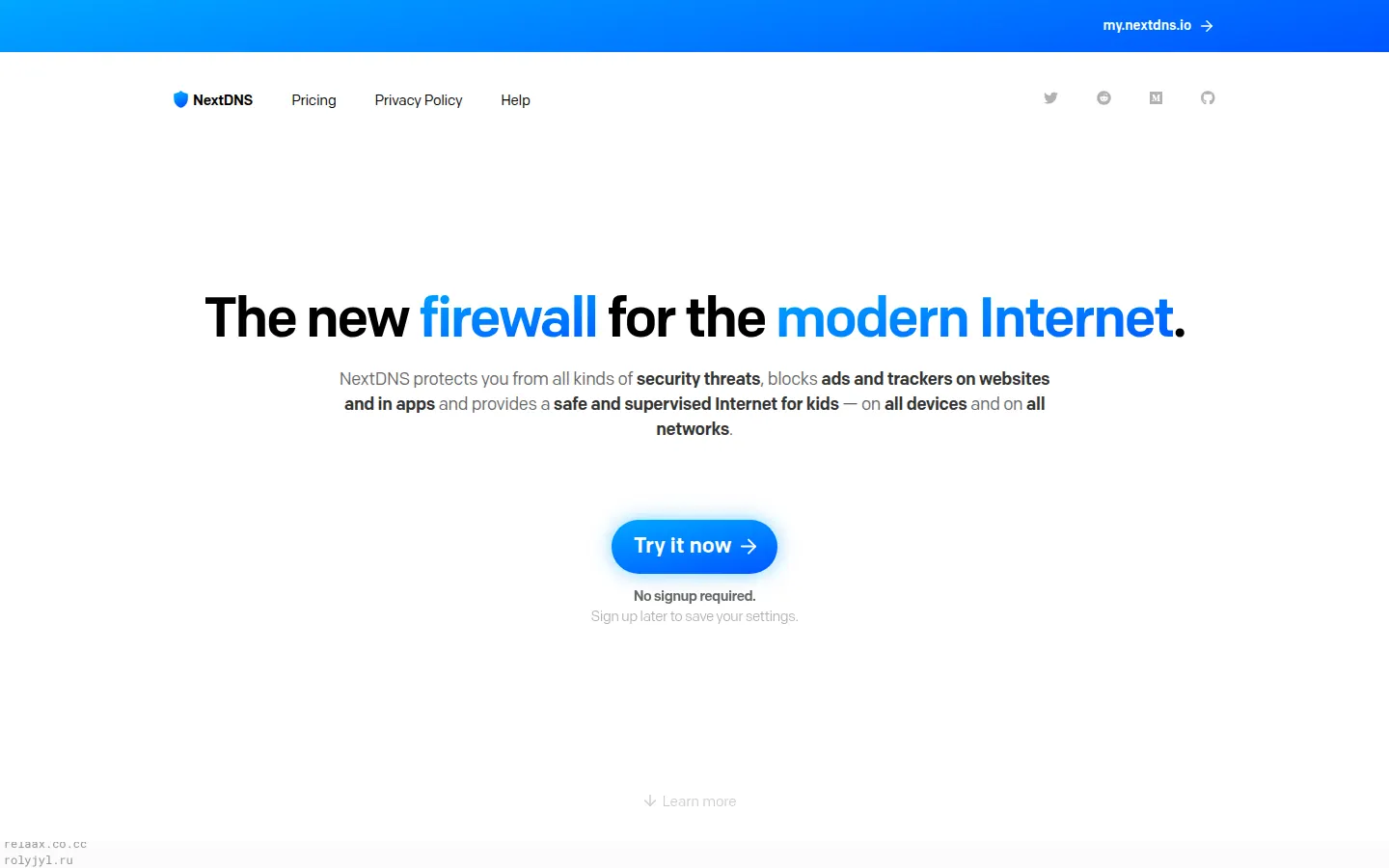
NextDNS (configurable DoH/DoT DNS filtering) homepage - live capture 2026-09-29
NextDNS is a configurable cloud DNS filtering tool (DoH/DoT/DoQ), not a VPN. It blocks ads, trackers, malware domains and enables parental controls at the network level by securing and filtering DNS queries. Run by NextDNS Inc. (founded 2019 by ex-Dailymotion engineers), it offers granular control, analytics, and user-managed logging. The core caveat: it does not hide your IP, encrypt traffic beyond DNS, or replace a browser ad blocker - this is one layer, not a full privacy stack.
Logging & privacy
NextDNS claims no logging unless explicitly enabled by the user, under a “What You See Is What We Have” policy: when logging is off, request data is discarded immediately. However, this claim rests solely on the operator’s privacy policy - classified as policy-only evidence, with no third-party audit or transparency report. Logging is user-controlled (retention from 1 hour to 2 years) and storage location can be set to the US, EU, UK, or Switzerland. QNAME minimisation and anonymized EDNS Client Subnet are enforced. Crucially, Privacy Guides notes that account creation enables insights and logging by default, meaning the “no logs” stance is a manual setting, not the out-of-box state. Jurisdiction is reported as the United States, with no warrant canary.
Pricing & the renewal trap
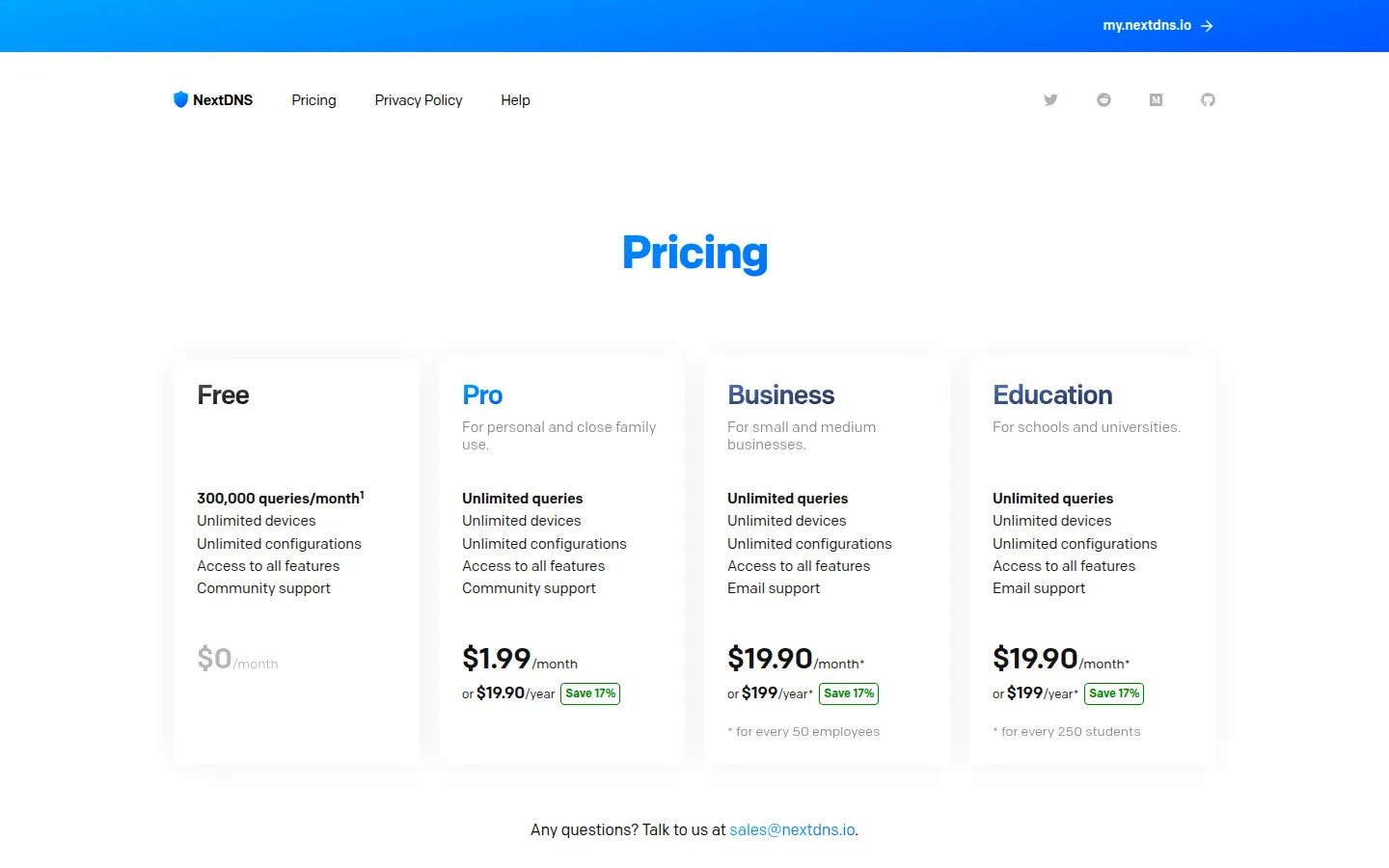
NextDNS (configurable DoH/DoT DNS filtering) pricing page - live capture 2026-09-29
There is no renewal trap: the price is flat at $1.99/month or $19.90/year for the Pro plan (personal and family use). The renewal ratio is 1, meaning no price jump after the first term. The Free tier offers 300,000 queries/month - enough for light use but exhausted in days by a household - after which filtering stops silently while DNS resolution continues. Payment methods include cards, PayPal, and cryptocurrencies via BitPay. No refund window is published, and the billing cycle is monthly by default, though annual payment saves 17%. The three_year_cash_total is null in derived_pricing, so the exact three-year cost cannot be verified from available data.
Features & performance
NextDNS supports DNS-over-HTTPS (DoH), DNS-over-TLS (DoT), and DNS-over-QUIC (DoQ), with user-selectable blocklists, security filters (e.g., cryptojacking, typosquatting), parental controls, and real-time analytics. It works on all devices via router, OS, or app-level configuration, including IoT and smart TVs. The service is open-source (CLI tools on GitHub) and scales to 132 server locations. However, it lacks a kill switch, split tunneling, multihop, or dedicated IP features - expected, as it’s not a tunneling service. P2P and streaming are unaffected since IP masking isn’t provided. Performance claims (e.g., latency) are not independently tested here, but user reports cite occasional resolution delays and outages, with no public status page to verify uptime.
Ownership & track record
NextDNS Inc. is described as founder-owned and independent, with no corporate parent or affiliate ties disclosed. Founders are Romain Cointepas and Olivier Poitrey, both with engineering backgrounds at Dailymotion and Netflix. Data quality is verified via operator pages, independent reviews, and community archives. Red flags include the absence of audits or transparency reports despite handling sensitive DNS data, a 2020 incident where signup emails were sent to Intercom (a GDPR complaint, though not involving DNS logs), and recurring user complaints about poor support and development stagnation. Reliability anecdotes from 2026 on r/nextdns and HN report outages and latency issues, with no status page to confirm or address them.
Censorship resistance
NextDNS does not offer obfuscation methods like domain fronting or traffic masking, and its protocols (DoH, DoT, DoQ) are detectable and blockable by sophisticated censors. It is not designed for use in highly censored environments like China, Iran, or Russia. While it can bypass basic network-level filtering (e.g., school or ISP blocklists), it will fail under active DPI or state-level blocking. The service does not position itself as a censorship circumvention tool, and user reports confirm it has been blocked in parts of Russia due to Cloudflare infrastructure dependencies.
Verdict
NextDNS is a powerful, cost-effective DNS filtering layer for households and home offices wanting network-wide ad, tracker, and malware blocking with full control over logs. It’s not a privacy replacement for a VPN and does not hide your IP. Given the lack of audits and default logging with accounts, treat it as a convenience and control tool, not a trustless privacy guarantee. The flat renewal pricing and strong feature set make it safe to recommend for personal use - especially the free tier to test. There is no evidence this provider pays review sites; affiliate links exist but are disclosed.
++ Was hält stand
Exceptionelle Preis-Leistung: 19,90 US-Dollar/Jahr für unbegrenzte Abfragen, unbegrenzte Geräte und unbegrenzte Konfigurationen – live auf der Preisübersicht verifiziert (kostenlose Stufe: 300.000 Abfragen/Monat, alle Funktionen enthalten)
Echte Filterkontrolle auf Resolver-Ebene: 11 Sicherheitsschalter, 84+ Blocklisten, systemeigener Tracking-Schutz auf Betriebssystemebene, Kindersicherung mit Zeitplänen und Umgehungsblockierung – schützt Geräte (Smart-TVs, Konsolen, IoT), auf denen niemals eine Erweiterung läuft
Verschlüsseltes DNS standardmäßig über DoH/DoT/DoQ sowie erzwungene QNAME-Minimierung und anonymisierte interne ECS, die deine IP nicht gegenüber autoritativen Servern preisgibt (Datenschutzrichtlinie des Betreibers)
Protokollierung ist per Design nutzersouverän: Wähle die Aufbewahrungsdauer zwischen 1 Stunde und 2 Jahren oder keine, und wähle den Speicherort der Protokolle unter US, EU, UK oder Schweiz; WYSIWWH-Ansicht/Export/Löschung (Dokumentation des Betreibers)
Von Gründern gegründet und selbstfinanziert gemäß eigener Datenschutzrichtlinie ('100 % finanziert, besessen und kontrolliert von den Gründern'), dokumentiert kein Druck durch Risikokapital; Mozilla TRR-Partner seit Dezember 2019
Open-Source-MIT-CLI-Client und ein gut gepflegtes öffentliches Blocklisten-Repository; native OpenWrt- und Tailscale-Integrationen
Wird von der unabhängigen Datenschutz-Community breit empfohlen (Privacy Guides Cloud-basierte DNS-Filterungsempfehlung, aktualisiert September 2026) mit einer Community-Bewertung von 4,7/19 auf PrivacyTools.io
-- Worauf du achten solltest
Kein VPN und kein Datenschutztunnel: Es verbirgt deine IP nicht, ändert deinen Standort nicht und sieht nur Domain-Abfragen, niemals Seiteninhalte (klar von The Unhacked und TechODash erklärt)
Die kostenlose Stufe versagt stillschweigend: Nach 300.000 Abfragen/Monat wird das Blockieren ohne Warnung eingestellt, während DNS weiterhin auflöst – der Schutz verschlechtert sich unsichtbar (Fußnote des Betreibers + Bitdoze/TechODash)
Support ist unterhalb der Business-Stufe nur über die Community verfügbar; 'absolut kein Support' und 'kein Kundensupport' sind wiederkehrende Beschwerden aus 2026 auf HN, und zwei Nutzer berichten, wegen dessen zu Control D gewechselt zu haben
Die Entwicklungsgeschwindigkeit und Kommunikation haben laut Bewertungen aus 2026 sichtbar nachgelassen; keine öffentliche Statusseite, kein Transparenzbericht, keine unabhängige Prüfung
Die Grenzen der DNS-Ebene sind strukturell: YouTube-/gleichdomänenbezogene Werbung überlebt, Malware mit Raw-IP und hartcodierten DNS-Adressen umgeht es, und jeder Nutzer kann die Filterung umgehen, indem er DNS ändert oder ein VPN nutzt
DNSPerf-basierte Vergleiche platzieren es mittelmäßig bei der Latenz (etwa 25–30 ms in Nordamerika gegenüber Cloudflares 8–11 ms), und Nutzer in r/nextdns berichten gelegentlich von langsameren Auflösungen und kurzen Ausfällen
Aggressive Listen (NRD, ganze TLD, HaGeZi Ultimate) verursachen Fehlalarme, die Anfänger aus den Protokollen schwer debuggen können
Preis-Realitätscheck
Einführungspreis
ca. 1,80 € /mo · Verlängerung ca. 1,80 €/Mon.
Verlängerungspreis
ca. 1,80 €/Mon.
Hinweise
Live-Preisübersicht vom 2026-11-03: Kostenlos 0 US-Dollar (300.000 Abfragen/Monat), Pro 1,99 US-Dollar/Monat oder 19,90 US-Dollar/Jahr (für private Nutzung und enge Familie), Business 19,90 US-Dollar/Monat oder 199 US-Dollar/Jahr pro 50 Mitarbeiter, Bildung 19,90 US-Dollar/Monat oder 199 US-Dollar/Jahr pro 250 Schüler. Alle Preise in US-Dollar. 'Wir akzeptieren Karten, PayPal und Kryptowährungen' (BitPay wird in der Datenschutzrichtlinie als Krypto-Processor genannt)
Der Geldfluss - was Testportale mit dieser Empfehlung verdienen
Affiliate-Status noch nicht verifiziert
Sollten wir dieses Programm joinen, wird jeder Link hier rel="nofollow sponsored" und läuft über /go/. Bis dahin zeigen unsere Links direkt auf die Anbieter-Website, ohne jegliches Tracking. Die Ranking-Logik kann Affiliate-Felder physisch nicht lesen - hier der Beweis.
On the website
Captured by our screenshot bot from the live site (or its public archive). A capture is evidence of what the page showed at capture time - not an endorsement.
NextDNS (configurable DoH/DoT DNS filtering) homepage - live capture 2026-09-29NextDNS (configurable DoH/DoT DNS filtering) pricing page - live capture 2026-09-29
Bevor du zahlst: prüfe den Verlängerungspreis, das Erstattungsfenster und ob ein günstigerer oder Gratis-Weg deinen Anwendungsfall abdeckt - die ehrliche Checkliste.
Ist NextDNS (configurable DoH/DoT DNS filtering) seriös?
Stand unserer Prüfungen: 2026-11-03. NextDNS (configurable DoH/DoT DNS filtering) erreicht 3.6/10 in unserem gewichteten Review. Wir haben 4 rote Flaggen vermerkt (oben aufgelistet). Nutzerberichte, Eigentum und die Vorfallhistorie sind mit datierten Quellen im Meta-Review unten dokumentiert.
What do I actually get for $1.99/month?
Full access to all filtering features, unlimited devices, user-controlled logging with jurisdiction choice, and priority support. The yearly plan ($19.90) saves 17% over monthly billing.
What is the renewal price and total cost over three years?
The renewal price is $1.99/month - the same as the intro rate. The **three_year_cash_total** is null in derived_pricing, so the exact three-year cost cannot be verified.
What proof is there that NextDNS doesn’t log my data?
Only the operator’s privacy policy supports the no-logs claim - classified as **policy-only**. There is no independent audit or transparency report.
Does it work in countries with heavy censorship like China or Iran?
No. NextDNS lacks obfuscation and is detectable; it is not suitable for use in China, Iran, Russia, or similar environments.
Can I pay and sign up anonymously?
Yes. Email signup requires no ID, and cryptocurrency payments are accepted via BitPay, though specific coins aren’t listed.
What happens if NextDNS shuts down or stops working?
Your DNS queries will fail until you switch to another resolver. The free tier continues as unfiltered DNS after quota, but blocking stops.
What’s the honest free or cheap alternative?
Use the free tier (300,000 queries/month) or switch to a public encrypted resolver like dns.nextdns.io, Cloudflare (1.1.1.1), or Quad9 - but without custom filtering or analytics.
Der Meta-Review: was das Internet über NextDNS (configurable DoH/DoT DNS filtering) sagt
Wir erwarten nicht, dass du uns vertraust. Dieser Review ist ein Meta-Review: unten siehst du, was andere Testportale behaupten - mit ihren Interessenkonflikten gekennzeichnet -, was Nutzer auf Reddit und in Foren berichten und wer NextDNS (configurable DoH/DoT DNS filtering) wirklich betreibt. Jede Behauptung verlinkt ihre Quelle, damit du sie selbst prüfen kannst.
Was andere Tester sagen (5)
Jede Quelle trägt ein Konflikt-Label aus unserer Testportal-Datenbank. „Affiliate-finanziert“ heißt: Die Seite verdient mit, wenn du kaufst, was sie empfiehlt. Kritische Stimmen nehmen wir bewusst auf.
Fetched live 2026-11-03 (HTTP 200): independent SOHO review, 4.3/5, affiliate-disclosed ('may earn a small commission'). Strongest cons list found: development slowed and the company 'communicates very little'; community-only support; Business tier thin for its price; free tier is 'a two-week trial for one person' that 'fails open silently'; no transparency report or independent audit; YouTube ads unaffected; per-device visibility requires the CLI/apps. Also quantifies latency expectations (DNSPerf mid-pack, 25-30ms NA vs Cloudflare 8-11ms) and names it 'a US-based company'. Verdict: strong buy for home/remote users, caution for business.
Fetched live 2026-11-03 (HTTP 200): two years of whole-network use; documents the 2025-2026 feature waves (Bypass Age Verification shipped August 2025 on all plans, log data residency US/EU/UK/CH, Tracker Insights), the 11-toggle security tab, 84+ blocklists with concrete recommendations (OISD, AdGuard DNS filter, Steven Black, HaGeZi ladder), the free-tier quota cliff ('blocking silently stops... no warning anywhere in the UI'), the missing status page ('there is no status.nextdns.io'), the honest logging note that the live query view still shows requests even with logging off, and that the CLI is MIT-licensed at v1.47.x (mid-2026). Affiliate link used (go.bitdoze.com/nextdns).
Fetched live 2026-11-03 (HTTP 200): disclosure-first review (affiliate link on the /go/ route, disclosed). The most useful section is 'What NextDNS does not do': does not hide your IP, does not see or protect page content, cannot block traffic that skips DNS (hardcoded IPs), is not antivirus, same-domain trackers are hard, router-only setup stops at the front door, some VPNs bypass it, over-blocking happens. Also documents that the operator pages do not state where the company is incorporated, that no independent audit was found, and that scale figures (100B queries/month) are self-reported. Verdict: worth trying on the free tier; 'not a VPN and does not hide your IP address, so treat it as one layer rather than a complete privacy stack'.
Fetched live 2026-11-03 (HTTP 200): mainstream editorial hands-on (Andy Walker), run after a reader survey where 23% of 4,169 respondents already used NextDNS and 36% were considering it. Confirms the no-app nature (Android Private DNS hostname), the ~87,000-entry default blocklist, Native Tracking Protection as beta, TLD blocking, parental controls including blocking bypass methods like VPNs and Tor, and the analytics value. Caveats given: the 300k query cap ('10,000 queries in two days' on one phone) and that standalone ad-blockers have no query limit. Site carries affiliate links.
Fetched live 2026-11-03 (HTTP 200): community-maintained listing, 4.7 from 19 user ratings, tagged Ad Blocking + DNS, 'Based in United States', 'Supports: DNS-over-TLS (DoT), DNS-over-HTTPS (DoH) and DNSCrypt' (the DNSCrypt claim is contradicted by r/nextdns users - NextDNS speaks DoH/DoT/DoQ, and DNSCrypt works only via proxy). 'Our take': strong network-level blocker whose edge is control (per-device profiles, parental controls, tunable logs); honest note that it is a cloud service so you trust NextDNS with your queries, and the free tier has a cap. NOTE on provenance: the site carries an affiliate link on this page, and per the site's own research file (review_sites.json, 2026-09-27) privacytools.io is community-labeled but operator-unclear since the 2024 community split to Privacy Guides - weight accordingly.
Was Nutzer sagen (3)
Reddit, Foren, HN - paraphrasiert und verlinkt, nie aus dem Kontext gerissen. Anekdoten, keine Beweise - aber Erstattungsbeschwerden und Leak-Reports sind das beste Frühwarnsystem, das dieser Markt hat.
Fetched live 2026-11-03 (HTTP 200): 2026 HN voices show both poles - strong blocking/value praise (fake-shop and phishing domains blocked, TV telemetry blocked, families covered, Pi-hole refugees citing reliability) against a consistent complaint cluster: 'absolutely zero support', 'not innovating at all' with departures to Control D, and the 300k free-quota cliff being burned by chatty devices. Full comment texts cited individually in the voices array.
Fetched live 2026-11-03 (HTTP 200): the canonical threads - 'Show HN: nextdns.io - A Combination of Cloudflare DNS and Pi-Hole' (May 2019, 372 points, 146 comments, posted by the company), 'NextDNS Is Out of Beta' (May 2020, 334 points), 'NextDNS is my new favourite DNS service' (Apr 2020, 350 points), 'Show HN: NextDNS Adds Bypass Age Verification' (Aug 2025, 537 points, 199 comments, founder-posted with the text 'handing over government documents to random sites is a huge privacy risk'), 'NextDNS Joins Firefox's Trusted Recursive Resolver' (Dec 2019, 144 points), Tailscale integration blog (Oct 2022), and the adversarial 'Tell HN: Nextdns.io, a privacy company, leaks users' email and violates GDPR' (Nov 2020 - Intercom email transmission on signup).
Fetched live 2026-11-03 (HTTP 200): 25 recent r/nextdns comments (Sept-Nov 2026). Signal mix: reliability complaints ('fail to resolve DNS 8-10 times per day', 'brief outages yesterday', Minneapolis image-loading stalls fixed by switching to 1.1.1.1), protocol corrections (no DNSCrypt), VPN coexistence workarounds (Proton/Nord + iOS profiles + linked-IP re-linking pain), a detailed cataloguing of 11 new Early Access security features (DNS Data Exfiltration, Fast Flux Networks present since September), and satisfied family/household users. NOTE: the instructed empty-body search (?body=&limit=25) returned HTTP 400; a body term was required - noted in data_quality.
KI-Fakten-Report - alles, was wir wissen, komprimiert
Erstellt von Qwen3 am 2026-11-03 aus unserer Faktendatenbank plus den verlinkten Quellen. Er fasst zusammen - er fügt keine Fakten hinzu. Prüfe alles Wichtige gegen die verlinkten Quellen.
Bottom line: NextDNS is a DNS filtering tool, not a VPN. It blocks ads, trackers and malware domains across all devices on your network for $1.99/month, with full user control over logging. It does not hide your IP, encrypt traffic beyond DNS, or bypass geoblocks.
The logging truth: The operator claims no logging unless enabled by the user, with data discarded immediately if off, under a "What You See Is What We Have" policy. Evidence is policy-only: no independent audit or transparency report exists. Logging jurisdiction is user-selectable (US, EU, UK, CH), but the company, NextDNS Inc., is US-based, and account creation enables logging by default for features.
Pricing reality: Pricing is flat at $1.99/month or $19.90/year - no bait-and-switch. A free tier offers 300,000 queries/month, unlimited devices, all features, but filtering silently stops when quota is exceeded, with no in-app warning. Crypto payments accepted via BitPay, no KYC.
What reviewers say vs what users say: Affiliate reviewers (TechODash, Android Authority, PrivacyTools.io) praise control, value and ease of use, calling it best-in-class for network filtering. Users confirm effectiveness but report reliability issues - outages, slow resolution - and near-zero support. Conflict: reviewers highlight privacy; users note silent filtering failure and stagnation, with some migrating to Control D.
Who runs it: Founded in 2019 by Olivier Poitrey (ex-CTO of Dailymotion, Director of Engineering at Netflix) and Romain Cointepas. The company is 100% founder-owned, US-based, with no outside investment disclosed. No public corporate address or incorporation details.
Quellen & wie dieser Review entstand
Jede externe Quelle, die auf dieser Seite verwendet wird, mit dem Abrufdatum und ihrer Belegklasse [A]-[D] (A = Primär-/Betreiberquelle, B = seriöse Presse/Forschung, C = Community, D = eigene Messungen). Methodik: wie wir verifizieren. Quellen verschwinden oder ändern sich - falls ein Link tot ist, sag uns über die Kontaktseite Bescheid.
Evidence classes on this page:[A] A: 4[B] B: 7[C] C: 3[D] D: 0(D stays empty until our own test phase)
A censorship-unblocking tool that now wears nonprofit clothes: Lantern's parent became the 501(c)(3) Brave New Software Project and the site now reads like a…
A DNS-layer filtering service that has grown up in public: born January-April 2021 out of the Windscribe team (same three founders, spun out precisely because…
Open Source
Einstieg ca. 2,70 € /mo
Canada - CONTROLD, Inc., Toronto, Ontario; operator about-us page states 'Founded in 2021 - Toronto, Canada' and site footer reads '2026 CONTROLD, Inc.'; free-dns FAQ calls it 'based in Toronto, Canada... the sister company of Windscribe'datenschutz-werkzeug vor 42 Std.
Hysteria 2 is not a VPN provider - it is free, MIT-licensed proxy software you deploy on your own server, and this dossier treats it that way: there is no…
Open Source
Einstieg ca. 4,40 € /mo
none - Hysteria is not a company; it is MIT-licensed open-source software (Go) developed by a volunteer community around lead developer 'Toby' (GitHub: tobyxdd), with the repo on GitHub and docs at hysteria.networkdatenschutz-werkzeug vor 42 Std.



Noch keine Kommentare - sei der Erste. Das Posten läuft durch einen kurzen Proof-of-Work in deinem Browser (Anti-Spam), kein Konto nötig.