AdGuard DNS (public + personal encrypted DNS) Review
Die gängige Standardlösung auf DNS-Ebene, mit einer tatsächlich ehrlichen Einordnung, die der Betreiber selbst klarstellt: AdGuard DNS sitzt am Resolver – es verschlüsselt DNS-Anfragen (DoH/DoT/DoQ/DNSCrypt) und blockt Werbe-, Tracking-, Malware- und Adult-Content-Domains netzwerkweit, auch auf Smart-TVs, Konsolen und IoT-Geräten, auf denen niemals eine Browsererweiterung läuft; es verbirgt NICHT deine IP, ändert NICHT deinen Standort und verschlüsselt NICHTS jenseits von DNS – so steht es wörtlich in der bewertungsreifen Werbung und im Wissensdatenbank des Betreibers („DNS-Blockierung allein kann kein kosmetisches Filtern bieten“, „verwende DNS in Kombination mit VPN und Werbeblocker“). Es ist auf der öffentlichen Ebene kostenlos, kostet 19,99 $/Jahr für das Personal-Dashboard (verifiziert, aktuell am 2026-11-03), und ist ungewöhnlich gut dokumentiert: Der Resolver-Code ist AGPL-3.0 Open Source, Privacy Guides listet es als empfohlenen öffentlichen Resolver mit anonymisiertem ECS und signierten Apple-Profilen, und der Betreiber führt sein eigenes Rechenzentrum in Frankfurt unter einer zypriotischen, DSGVO-konformen Rechtsform. Die ehrlichen Schwachstellen: Das private Dashboard ist nur nützlich, wenn die Protokollierung von Anfragen aktiviert ist, es existiert keine unabhängige Prüfung des DNS-Dienstes (Nachweise zur Protokollierung basieren allein auf der Richtlinie), der öffentliche Resolver führt eine rotierende 24-Stunden-Datenbank anonymisierter Domains, eine Reihe neuer Vorfälle im Oktober-November 2026 betrafen das Dashboard und die Zustellung der Abfrageprotokolle, und die russische Herkunft stößt nach wie vor auf Community-Abneigung, die die zypriotische Firmensitzverlegung nicht auslöscht. Als Filter ist es hervorragend; als Datenschutzgarantie ist es eine Schicht in einem System – und anders als ein VPN tut es nicht einmal so, als wäre es mehr.
Open Source6 rote FlaggenFakten verified - operator pages (welcome/license + embedded USD pricing JSON/datenschutz/public-dns/ueber-uns/KB/archive-today-investigation blog), status.adguard.com, Wikipedia article + summary API, GitHub API for AdguardTeam/AdGuardDNS, Privacy Guides DNS recommendations, two independent reviews (privacytools.io app page, work-management.org 2026 review), HN Algolia (comments + story index) and arctic-shift Reddit archives (r/Adguard body-search + r/ControlD link_id thread) all fetched live 2026-11-03. Note: body-searches on r/adguard (body=dns) and r/pihole (body=adguard) returned HTTP 422 - the known arctic-shift failure mode - so the second subreddit was pulled via the link_id thread endpoint instead; one KB deep link 404ed (adguard-dns.io/kb/general/dns-based-filtering/) and was dropped.
Logging posture is policy-only, not audited: the public resolver keeps a rolling 24-hour anonymous database of every requested domain (explicitly unlinkable per the policy, and footnoted by Privacy Guides), and the private product logs queries by default with device names, company names and optional subnet-limited IPs - opt-out, not opt-in (privacy policy + Privacy Guides, both fetched live 2026-11-03)
November 2025 archive.today affair: a recently registered French 'Web Abuse Association Defense' demanded AdGuard DNS block archive.today under French LCEN law with what AdGuard's own investigation found to be forged bailiff reports; AdGuard refused, verified the content was removed directly by Archive.today, and filed a complaint with French police - a live demonstration that DNS resolvers are censorship pressure points, and credit to the operator for publishing the whole affair (operator blog Nov 13, 2025; HN thread 1,816 points / 443 comments)
October-November 2026 incident cluster on the status page: 'AdGuard DNS - private DNS query log delay' with up to 15% of query logs since 14.10.2026 missing during the incident, a data-center-provider outage that took the DNS dashboard offline while 'DNS resolving works properly', and a dashboard outage on Nov 2 ('No query logs were lost') - matching the community 'AdGuard DNS down today' thread on r/Adguard
+3 weitere rote Flaggen - vor der Anmeldung aufklappen
Russia provenance: Wikipedia documents AdGuard was 'founded as a private company in Moscow, Russia in 2009' before moving to Cyprus; a r/Adguard comment in the November 2026 sale thread attacks the brand as 'based in Russia' - the operator's Cyprus registration and GDPR framing are documented, but the origin is not deniable
September 2018 credential-stuffing attack on AdGuard accounts (company reset all passwords as a precaution; CNET/Wikipedia); AdGuard for Android was removed from Google Play in late 2014 (Wikipedia + operator blog) and has been distributed from the company's own site since
Website-security optics: privacytools.io notes adguard.com scores an F on Mozilla HTTP Observatory for weak security headers - measured against the tool's own website, not the DNS service
Review
Entwurf von Qwen3, faktengeprüft von der vpnvergleich-Redaktion · Review-Version 2 · Text aktualisiert 2026-11-03 · Fakten Stand 2026-11-03 · wie wir verifizieren
Ehrlichkeits-Hinweis: wir haben keine eigenen Tests zu AdGuard DNS (public + personal encrypted DNS) gelaufen (Leak-Tests, Tempo, Kill Switch). Alles auf dieser Seite ist quellbasierte Meta-Recherche mit datierten Links. Sobald wir testen, erscheinen die Ergebnisse hier und im Änderungsprotokoll.
Overview
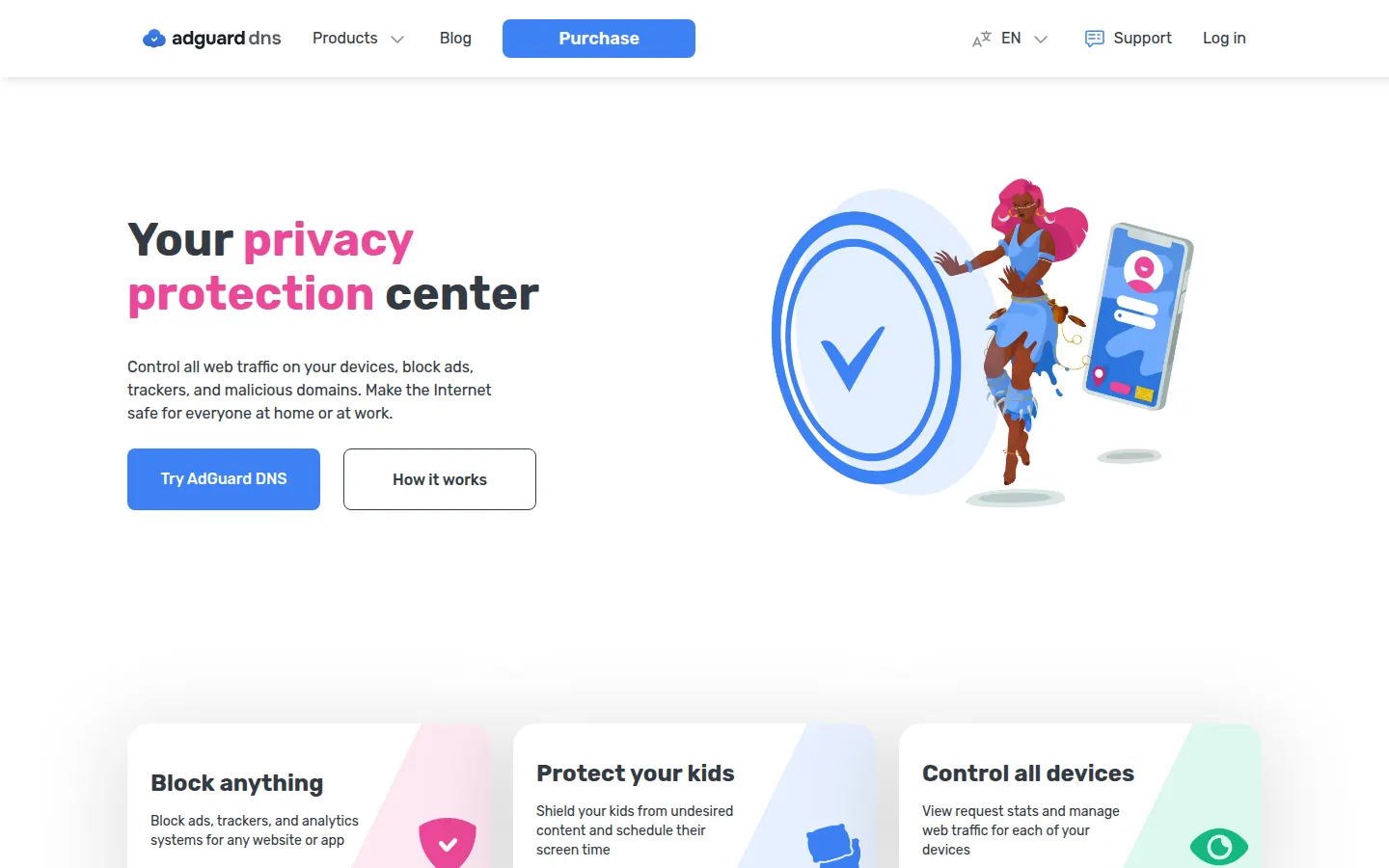
AdGuard DNS (public + personal encrypted DNS) homepage - live capture 2026-09-29
AdGuard DNS is a public and personal encrypted DNS resolver (DoH/DoT/DoQ/DNSCrypt), not a VPN. It blocks ads, trackers, and malicious domains at the DNS level across all devices, including smart TVs and consoles, without requiring apps. Run by Adguard Software Limited in Cyprus, it’s backed by a 17-year-old company with open-source code and GDPR compliance. But it doesn’t hide your IP, encrypt general traffic, or change your location - this is filtering, not anonymity.
Logging & privacy
The public resolver claims no personal data is processed, storing only aggregated metrics and a 24-hour rolling database of anonymized domains - explicitly unlinkable to users per its policy, a claim echoed by Privacy Guides. For the private service, DNS query logs (including device names, company owners, and optional subnet-limited IPs) are stored by default but can be disabled and retention customized in settings. Logging evidence is policy-only - no audit, transparency report, or warrant canary exists. Data resides in Frankfurt, Germany, under EU jurisdiction, but the lack of independent verification means trust rests entirely on AdGuard’s word.
Pricing & the renewal trap
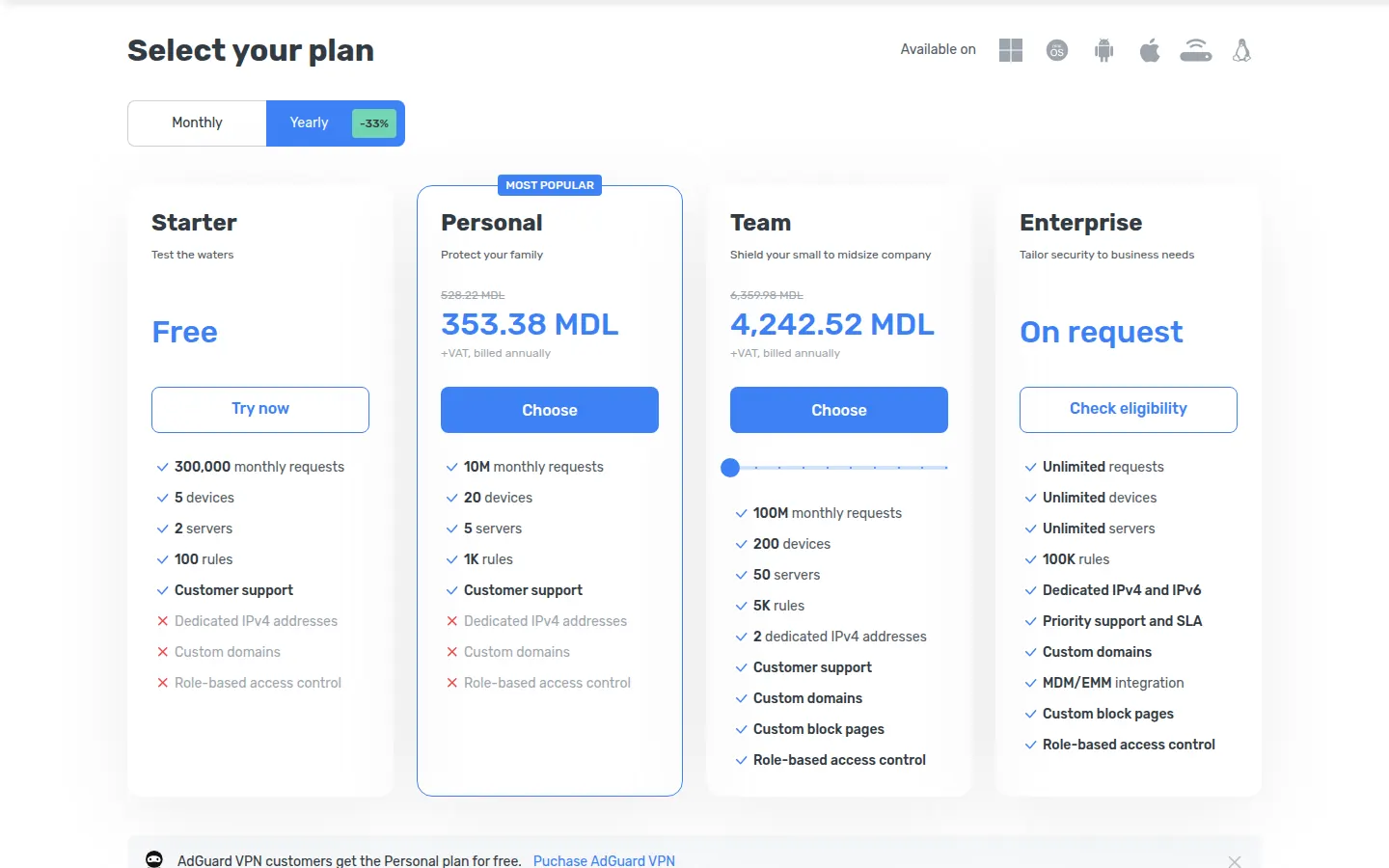
AdGuard DNS (public + personal encrypted DNS) pricing page - live capture 2026-09-29
There’s no bait-and-switch: the Personal plan costs $19.99/year (about $1.67/month), with no lower intro rate. The renewal ratio is 0.7, meaning you pay less per month on renewal - a rare upside. Monthly billing is $2.49, non-refundable; annual subscriptions get a 30-day money-back guarantee. A free Starter tier offers 300,000 requests/month, 5 devices, and support. Payments go through Paddle (card-only), with no crypto option. The real 3-year cost for annual billing is not computed due to lack of multi-year billing events.
Features & performance
Supports DoH, DoT, DoQ, DNSCrypt, and plain DNS on ports 53/5353, with DNSSEC and ECS anonymization. Offers network-wide filtering, parental controls, custom blocklists, and typosquatting protection. Open-source (AGPL-3.0), with 100+ servers in 15+ countries. Works on any device that allows custom DNS - routers, smart TVs, consoles, mobile, desktop. No kill switch, split tunneling, or multihop. Performance claims like low latency or streaming unblocking aren’t tested here; user reports cite regional lag, especially from Spain to London nodes.
Ownership & track record
Operated by Adguard Software Limited, Cyprus-registered since moving from Moscow, Russia, where the company was founded in 2009. Despite GDPR framing, the Russian origin still draws criticism, as seen in Reddit threads. The company is independent, user-funded, and maintains 90+ public repos. No known affiliate payouts. Incidents include a 2018 credential-stuffing attack, 2024 removal from Google Play (resolved via direct distribution), and a 2025 censorship pressure event where AdGuard refused forged takedown demands. Recent 2026 outages affected dashboard access and log delivery, with partial data delays reported.
Censorship resistance
AdGuard DNS offers no obfuscation tools and is not designed for use in heavily censored environments like China or Iran. While it encrypts DNS queries, it does not disguise traffic patterns or bypass deep packet inspection. The resolver’s refusal to comply with forged French takedown demands in 2025 shows principled resistance, but it lacks the tunneling or camouflage needed for true censorship evasion. For such use cases, consider tools built for that purpose - this isn’t one.
Verdict
AdGuard DNS is a solid choice for households wanting simple, network-wide ad and tracker blocking across all devices, especially where apps can’t run. It’s transparent, open-source, and reasonably priced at $19.99/year, with no renewal trap. But it’s not a privacy panacea: logging is policy-only, the private dashboard requires opt-out logging, and it offers zero IP masking. This tool doesn’t pay review sites, but you’re still trusting AdGuard’s un-audited claims. Pair it with a real VPN and ad blocker for full coverage.
++ Was hält stand
Starkes, überprüfbares Filtern am Resolver: Werbung, Tracker, Malware, Phishing, plus optionale Blockierung von Adult-Inhalten, Elternkontrollen mit Kategorien und Zeitplänen – funktioniert auf TVs, Konsolen und IoT-Geräten, die keine Erweiterungen ausführen können (Betreiberseiten + work-management.org-Review)
Jedes moderne verschlüsselte DNS-Protokoll an einem Ort: DoH, DoT, DoQ und DNSCrypt, plus DNSSEC; die Betreiber-FAQ behauptet erste öffentliche Resolver-DoQ-Unterstützung, und ~75 % des Datenverkehrs sind verschlüsselt (KB)
Kostenlos an beiden Zugangspunkten: öffentliche Server ohne Konto und ein privater Starter-Plan mit 300.000 Anfragen/Monat, 5 Geräten, 100 Regeln (verifiziert live am 2026-11-03)
Der DNS-Server-Code ist AGPL-3.0 Open Source (github.com/AdguardTeam/AdGuardDNS, Go, aktiv gepusht am 2026-10-19) innerhalb einer Organisation mit über 90 öffentlichen Repos
Privacy Guides listet AdGuard Public DNS als empfohlenen öffentlichen Resolver: anonymisierte Protokollierung, anonymisierte ECS, signierte Apple-Profile – Kriterien, die DNSSEC, QNAME-Minimierung und keine Protokollierung personenbezogener Daten auf Festplatte erfordern
Personenbezogene Daten verbleiben im eigenen Frankfurter Rechenzentrum des Betreibers unter einer zypriotischen, DSGVO-konformen Entität; die Datenschutzrichtlinie ist ungewöhnlich konkret darüber, was protokolliert wird und was nicht (Datenschutzrichtlinie, live abgerufen)
Aggressiv preisgestaltet: 2,49 $/Monat oder 19,99 $/Jahr für 10 Mio. Anfragen und 20 Geräte, kostenlos für AdGuard-VPN-Abonnenten (Lizenzseite, verifiziert live)
-- Worauf du achten solltest
Kein VPN und kein Datenschutz-Tunnel: es verbirgt deine IP nicht, ändert deinen Standort nicht und sieht nur Domain-Abfragen, niemals Seiteninhalte (klar im Betreiber-KB und durch work-management.org angegeben)
Keine unabhängige Prüfung und kein Transparenzbericht für einen Dienst, der, wenn die private Protokollierung aktiviert ist, eine Aufzeichnung jeder Domain speichern kann, die dein Netzwerk angefragt hat – das Vertrauen basiert allein auf dem Text der Betreiber-Richtlinie (keine Prüfung in irgendeiner abgerufenen Quelle gefunden)
Die Statistiken und Protokolle im privaten Dashboard hängen davon ab, dass die Abfrageprotokollierung aktiviert ist: das Deaktivieren der Protokollierung aus Datenschutzgründen entfernt die Sichtbarkeit, die der Verkaufsargument des kostenpflichtigen Produkts ist (work-management.org)
DNS-Ebene-Beschränkungen sind strukturell: keine kosmetische Filterung (leere Felder, wo Werbung war), First-Party-Werbung wie die von YouTube bleibt erhalten, Traffic mit hartcodierten IPs umgeht sie, und die Filterung kann gelegentlich Websites und Apps stören (work-management.org; HN und r/Adguard Threads)
Zuverlässigkeitsprobleme 2026: Berichte der Community über 'AdGuard DNS heute ausgefallen' (r/Adguard, Okt. 2026) bei einem Statuspage-Ereignis eines Rechenzentrumsanbieters (20. Okt.), das die Zustellung privater Abfrageprotokolle um bis zu 15 % verzögerte, sowie ein Dashboard-Ausfall (2. Nov.)
Geografische Lücke: Nutzer berichten von spürbarer Latenz, wenn kein lokaler Knoten vorhanden ist (Spanien leitet über London plus Verschlüsselungs-Overhead, r/Adguard Oktober 2026) – 15+ Standorte sind dünn im Vergleich zu Hyperscale-Resolvern
Support nur per E-Mail und langsam, wenn es darauf ankommt (Beschwerde in r/Adguard über unbeantwortete Support-Mails mit Logs, Okt. 2026)
Preis-Realitätscheck
Einführungspreis
ca. 2,20 € /mo · Verlängerung ca. 1,50 €/Mon.
Verlängerungspreis
ca. 1,50 €/Mon.
Erstattungsfenster
30 Tage
Hinweise
Live-Preisliste vom 2026-11-03 (USD-Preise extrahiert aus dem eingebetteten Preis-JSON der Seite): Starter kostenlos (300.000 Anfragen/Monat, 5 Geräte, 2 Server, 100 Regeln, Kundensupport); Personal 2,49 $/Monat oder 19,99 $/Jahr (10.000.000 Anfragen/Monat, 20 Geräte, 5 Server, 1.000 Regeln); Team ab 29,99 $/Monat oder 239,99 $/Jahr in der Einstiegsstufe (100.000.000 Anfragen/Monat, 200 Geräte, 50 Server, 5.000 Regeln, dedizierte IPv4-Adressen, benutzerdefinierte Domains, benutzerdefinierte Sperrseiten, rollenbasierte Zugriffssteuerung), skalierbar in Mengenstufen bis zu 2.000 Geräten / 1 Milliarde Anfragen für 299,90 $/Monat; Enterprise auf Anfrage (unbegrenzte Geräte, Server und Anfragen, jährlich zahlbar pro Nutzer oder pro 100 Mio. Anfragen). In einigen Regionen angezeigte Preise inklusive Mehrwertsteuer: 2,99 $/23,99 $. Zahlungen laufen über Paddle (im Impressum genannt); auf keiner abgerufenen Seite wurde eine Zahlungsoption mit Kryptowährung dokumentiert.
Der Geldfluss - was Testportale mit dieser Empfehlung verdienen
Affiliate-Status noch nicht verifiziert
Sollten wir dieses Programm joinen, wird jeder Link hier rel="nofollow sponsored" und läuft über /go/. Bis dahin zeigen unsere Links direkt auf die Anbieter-Website, ohne jegliches Tracking. Die Ranking-Logik kann Affiliate-Felder physisch nicht lesen - hier der Beweis.
On the website
Captured by our screenshot bot from the live site (or its public archive). A capture is evidence of what the page showed at capture time - not an endorsement.
AdGuard DNS (public + personal encrypted DNS) homepage - live capture 2026-09-29AdGuard DNS (public + personal encrypted DNS) pricing page - live capture 2026-09-29
Bevor du zahlst: prüfe den Verlängerungspreis, das Erstattungsfenster und ob ein günstigerer oder Gratis-Weg deinen Anwendungsfall abdeckt - die ehrliche Checkliste.
Ist AdGuard DNS (public + personal encrypted DNS) seriös?
Stand unserer Prüfungen: 2026-11-03. AdGuard DNS (public + personal encrypted DNS) erreicht 3.9/10 in unserem gewichteten Review. Wir haben 6 rote Flaggen vermerkt (oben aufgelistet). Nutzerberichte, Eigentum und die Vorfallhistorie sind mit datierten Quellen im Meta-Review unten dokumentiert.
What do I actually get with the paid plan?
The Personal plan gives 10 million requests/month, 20 devices, 5 servers, 1,000 rules, custom blocklists, parental controls, and query logging (optional). Dashboard analytics require logging enabled. No apps needed - just configure DNS on your devices or router.
What is the renewal price and total cost over three years?
The renewal rate is $19.99/year (about $1.67/month), with no separate intro discount. The three-year total isn’t computed due to lack of multi-year billing events, but annual renewals would cost $59.97 over three years at current rates.
What proof is there for the no-logs claim?
None beyond the privacy policy. The public resolver stores a 24-hour anonymized domain database; the private service logs queries by default, configurable in settings. No third-party audit or transparency report exists - evidence is policy-only.
Does it work in censored countries like China or Iran?
No. AdGuard DNS lacks obfuscation and tunneling. It encrypts DNS but doesn’t hide traffic patterns or bypass firewalls. It’s not built for censorship resistance - use tools designed for that instead.
Can I pay anonymously?
Partially. The public DNS requires no account. For the paid Personal plan, you need an email and card via Paddle - no crypto accepted. No ID verification is required, but your payment details are tied to the transaction.
What happens if the service shuts down?
You lose filtering and dashboard features, but your devices will fall back to your ISP’s DNS or whatever resolver you configure next. Since it’s DNS-based, switching is fast - just update your settings. No data lock-in, but no local filtering unless you self-host AdGuard Home.
What’s the honest free or cheap alternative?
Use the public AdGuard DNS servers (94.140.14.14 etc.) for free, no account needed. Or self-host AdGuard Home on a Raspberry Pi for full control. For more customization, try NextDNS (free tier available). All are better than nothing - but none replace a real ad blocker or VPN.
Der Meta-Review: was das Internet über AdGuard DNS (public + personal encrypted DNS) sagt
Wir erwarten nicht, dass du uns vertraust. Dieser Review ist ein Meta-Review: unten siehst du, was andere Testportale behaupten - mit ihren Interessenkonflikten gekennzeichnet -, was Nutzer auf Reddit und in Foren berichten und wer AdGuard DNS (public + personal encrypted DNS) wirklich betreibt. Jede Behauptung verlinkt ihre Quelle, damit du sie selbst prüfen kannst.
Was andere Tester sagen (2)
Jede Quelle trägt ein Konflikt-Label aus unserer Testportal-Datenbank. „Affiliate-finanziert“ heißt: Die Seite verdient mit, wenn du kaufst, was sie empfiehlt. Kritische Stimmen nehmen wir bewusst auf.
Fetched live 2026-11-03 (HTTP 200): community-maintained listing, 4.4 from 11 user ratings, tagged Ad Blocking + DNS + Open Source + Easy setup, 'Based in Europe' (Cyprus named). 'Our take': 'An easy on-ramp to DNS-level ad and tracker blocking: point two IP addresses at it and you're filtering across every device, no app required'; against NextDNS it offers 'less granular per-device customization'; 'Pick AdGuard DNS when you want blocking running in minutes with minimal fuss'. License explainer: AGPL-3.0, network clause highlighted. GitHub-at-a-glance widget: 963 stars, 82 forks, last commit 14d, 84% issues closed, Go 98.6%. Threat level 'Covered'. NOTE: page carries a disclosed affiliate link and an adguard.com website F-score note (Mozilla HTTP Observatory, tested 2d ago) - 'measures the security configuration of the tool's own website, not the privacy of the product'. Per the site's own research file (review_sites.json, 2026-09-27) privacytools.io is community-labeled but operator-unclear since the 2024 split to Privacy Guides - weight accordingly.
Fetched live 2026-11-03 (HTTP 200): the most useful independent limits list found - cannot reliably block first-party video ads (YouTube), no cosmetic filtering, filtering can occasionally break websites/apps, 'Private analytics require DNS query logging' (disable logs = lose the visibility), does not replace antivirus/VPN/SIEM; 'Encrypted DNS... does not encrypt all browsing traffic, conceal your public IP address, or prevent websites from identifying your browser.' Confirms plan matrix (Starter 300k/5 devices/100 rules; Personal 10M/20 devices; Team 100M+/200 devices; ~$2.49/mo Personal, ~$29.99/mo Team, AdGuard VPN subscribers get Personal free), parental controls (20+ categories, schedules, YouTube Restricted Mode), custom blocklists incl. password-protected via HTTP Basic Auth, country/ASN-based user rules, typosquatting and IDN-homograph protections, Frankfurt data residency. FAQ: 'Does AdGuard DNS replace a VPN? No.' Verdict: 'practical and affordable security layer... centralized domain filtering with privacy controls'.
Was Nutzer sagen (5)
Reddit, Foren, HN - paraphrasiert und verlinkt, nie aus dem Kontext gerissen. Anekdoten, keine Beweise - aber Erstattungsbeschwerden und Leak-Reports sind das beste Frühwarnsystem, das dieser Markt hat.
Fetched live 2026-11-03 (HTTP 200): 'Public DNS resolver that protects you from ad trackers' - AGPL-3.0, Go, 963 stars, 82 forks, 161 open issues, created 2018-12-12, last push 2026-10-19, topics incl. adblock, dns-over-https, dns-over-quic, dns-over-tls, dnscrypt, golang, open-source, privacy. This is the open-source AdGuard DNS server codebase (the hosted service's engine), one of 90+ public AdguardTeam repositories.
Fetched live 2026-11-03 (HTTP 200): 25 recent r/Adguard comments (Sept-Nov 2026). Signal mix: an 'AdGuard DNS down today' cluster (US Family config affected, Czechia fixed by unchecking AdGuard DNS filter + OISD Big, Sky Q box vs TV inconsistency), a Spain latency complaint (London hop + encryption noticeable, asks for closer servers), a 'based in Russia' attack comment in the sale thread, AdGuard Home recommended for third-party blocklists and client control, an unanswered-support-mail complaint, ambivalence about trusting it for banking-app-adjacent use, and AdGuard staff actively troubleshooting in-thread (VPN startup, private-browser YouTube ads). NOTE: the instructed body=dns variant and the r/pihole body=adguard variant both returned HTTP 422 (arctic-shift rate-limit/query failure mode) - noted in data_quality.
Fetched live 2026-11-03 (HTTP 200): 'I tested the top free DNS ad blocking services with the default configuration (NextDNS, Control D, Mullvad, AdGuard, LibreDNS, CleanBrowsing)' (Aug 2025, 27 comments). The thread itself was contentious (OP's methodology attacked by Control D staff and commenters; AI-graph accusations; deleted comments), with useful meta: DNS blockers cap at 78/100 on adblock-tester because cosmetic filtering is impossible at the DNS layer; 'they all use same blocklists'; the iOS-app-plus-Safari-extension pattern to cover what DNS cannot; several users comparing AdGuard DNS vs Control D and one current AdGuard user shopping for a better-tested alternative. Retrieved via the link_id thread endpoint after body-searches 422ed.
Fetched live 2026-11-03 (HTTP 200): recent HN voices span 2025-2026 - easy-setup endorsements ('Or just use these AdGuard DNS servers, no infrastructure setup needed' with the 94.140.x.x IPs; 'dns.adguard-dns.com in your phone DNS settings'; 'works wonders on Android' with the public-Wi-Fi caveat), satisfied system-wide setups (HaGeZi lists + content blockers; router + Smart-TV blocklists exposing LG telemetry), a self-hosted AdGuard DNS server account with iOS DNSSEC timeouts and upstream RTT measurements (Quad9 70ms / HE 20ms / Cloudflare 2-3ms), a NextDNS refund-refugee switching to AdGuard DNS, the Spanish ECS/La Liga workaround, the archive.today blocking-pressure discussion, and honest reminders that uBlock Origin 'does so much more' than any DNS blocker. Full texts cited individually in voices.
Fetched live 2026-11-03 (HTTP 200, 49 story hits): canonical threads - 'AdGuard DNS: A Privacy-Oriented DNS Server' (Dec 2018, 196 points, 107 comments), 'AdGuard DNS v2.0 goes open source' (Aug 2022), 'New AdGuard DNS milestone: the open beta' (Mar 2022), 'Reimagining AdGuard DNS' (Sep 2021, relaunch into the dashboard product), 'AdGuard DNS Outage' (Oct 2021, status.adguard.com incident link), and the major 2025 item: 'Our investigation into the suspicious pressure on Archive.today' (Nov 15, 2025, 1,816 points, 443 comments) plus its first submission (Nov 14, 2025, 18 points) - the community's most-visited AdGuard DNS story on record. Also: 'AdGuard Home v1.0 Beta' (Oct 2026).
KI-Fakten-Report - alles, was wir wissen, komprimiert
Erstellt von Qwen3 am 2026-11-03 aus unserer Faktendatenbank plus den verlinkten Quellen. Er fasst zusammen - er fügt keine Fakten hinzu. Prüfe alles Wichtige gegen die verlinkten Quellen.
Bottom line: AdGuard DNS is a widely used encrypted DNS resolver that blocks ads, trackers, and malicious domains across all devices by filtering at the domain level. It does not hide your IP, change your location, or encrypt traffic beyond DNS queries. It’s free for basic use, $19.99/year for the full personal dashboard, and works without apps - just configure DNS settings.
The logging truth: The public resolver claims no personal data is processed, but retains an anonymous 24-hour rolling database of requested domains (explicitly unlinkable per policy). The private service logs DNS queries by default - including device names, company owners of domains, and optional subnet-limited IPs - with retention and logging configurable and disableable in settings. Logging claims are policy-only; no independent audit or transparency report exists. Jurisdiction is Cyprus (GDPR-compliant), though the company originated in Russia.
Pricing reality: The Personal plan costs $19.99/year (about $1.67/month) with no lower intro rate - this is the standard price. There’s no bait pricing, but the lack of a discounted first term means no financial incentive to start. AdGuard VPN subscribers get the Personal DNS plan free. Payments go through Paddle, no crypto accepted.
What reviewers say vs what users say: Reviewers like Privacy Guides and privacytools.io recommend the public resolver for its privacy safeguards, open-source code, and ease of setup, rating it as a solid entry-level DNS blocker. However, user complaints on Reddit highlight recent reliability issues: October-November 2026 saw dashboard outages and missing query logs, slow email support, and latency outside major regions. Some users distrust the Russia-founded origin despite Cyprus incorporation. Reviewers appear neutral or affiliate-tied (privacytools.io has an affiliate link), while users report real-world hiccups that don’t break core functionality but affect trust.
Who runs it: AdGuard DNS is operated by Adguard Software Limited, registered in Limassol, Cyprus. The company was founded in Moscow, Russia in 2009 and later relocated to Cyprus, positioning itself as GDPR-compliant and user-funded. The team maintains open-source infrastructure and publishes detailed technical and legal responses, but the Russian origin remains a reputational friction point for some users.
Quellen & wie dieser Review entstand
Jede externe Quelle, die auf dieser Seite verwendet wird, mit dem Abrufdatum und ihrer Belegklasse [A]-[D] (A = Primär-/Betreiberquelle, B = seriöse Presse/Forschung, C = Community, D = eigene Messungen). Methodik: wie wir verifizieren. Quellen verschwinden oder ändern sich - falls ein Link tot ist, sag uns über die Kontaktseite Bescheid.
Evidence classes on this page:[A] A: 7[B] B: 6[C] C: 5[D] D: 0(D stays empty until our own test phase)
A censorship-unblocking tool that now wears nonprofit clothes: Lantern's parent became the 501(c)(3) Brave New Software Project and the site now reads like a…
A DNS-layer filtering service that has grown up in public: born January-April 2021 out of the Windscribe team (same three founders, spun out precisely because…
Open Source
Einstieg ca. 2,70 € /mo
Canada - CONTROLD, Inc., Toronto, Ontario; operator about-us page states 'Founded in 2021 - Toronto, Canada' and site footer reads '2026 CONTROLD, Inc.'; free-dns FAQ calls it 'based in Toronto, Canada... the sister company of Windscribe'datenschutz-werkzeug vor 42 Std.
Hysteria 2 is not a VPN provider - it is free, MIT-licensed proxy software you deploy on your own server, and this dossier treats it that way: there is no…
Open Source
Einstieg ca. 4,40 € /mo
none - Hysteria is not a company; it is MIT-licensed open-source software (Go) developed by a volunteer community around lead developer 'Toby' (GitHub: tobyxdd), with the repo on GitHub and docs at hysteria.networkdatenschutz-werkzeug vor 42 Std.



Noch keine Kommentare - sei der Erste. Das Posten läuft durch einen kurzen Proof-of-Work in deinem Browser (Anti-Spam), kein Konto nötig.